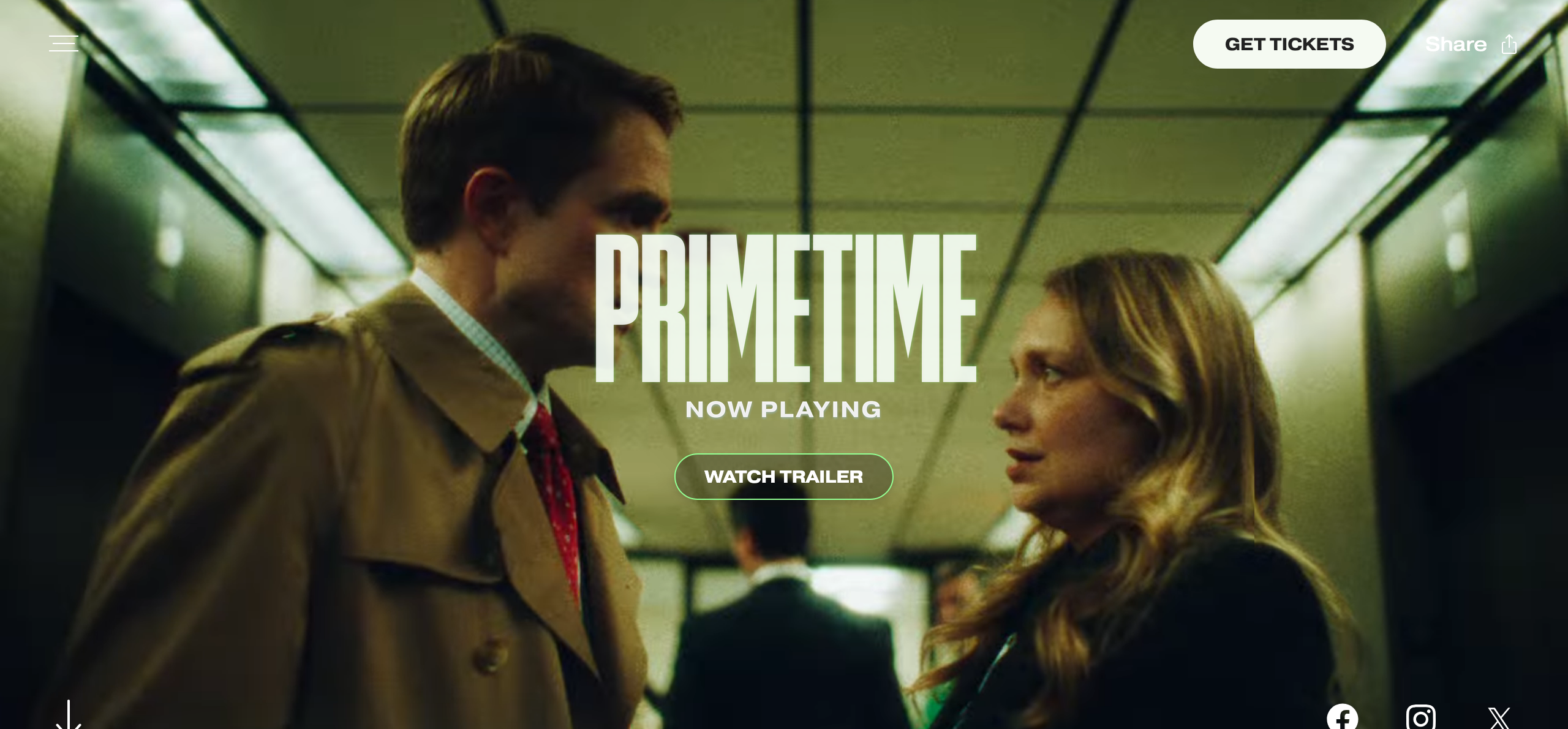
I am surprised by how much credible critics like Primetime, the new movie directed by Lance Oppenheim that I saw this week.
This movie, which is a 2007 Esquire article adaptation by Ajon Singh, is the story of a reality TV series about potential child sex predator stings. At its center are its host Chris Hansen (Robert Pattinson) and its producer Andie Bender (Merritt Weaver) and their collaboration with a vigilante justice group and the most recent decoy actor (Skylar Gisando).
Hansen and Bender want to compete with other primetime programs — Hansen is also hiding an affair from his estranged wife and confused kids — and the decoy wants a credit for his acting card. In their pursuit of these ends, they destroy the people around them and themselves.
Their choices and experiences are explored by Oppenheim, who brings his trademark blend of nonfiction, storytelling, and cinematic conventions to his first narrative feature film. This movie recreates a reality television experience, and also focuses on the wall between the screen and the audience, as it blurs lines between experience and narrative.
Critics cite his direction as well as powerful performances and even the cinematic experience as noteworthy elements of this movie, which I can understand. I however couldn’t get past the tensions between form and content, which masks underdeveloped characters and plot.
As a result, I couldn’t care about this story or these people no matter how interested in the larger questions I am.
I am intrigued by the way that narrative, and drama, shape experience and generate significance and meaning, and often asked first-year college students and English majors to consider these. I can easily imagine ways that these issues could be considered in this movie, and also ways it could ask more conventional content questions , such as one about ambition and ethics or culture and commodification.
It instead seems content with friction or flashes from crossing conventional craft and content boundaries that illuminate little if anything about this situation, its setting, these characters, or the world where we all live.
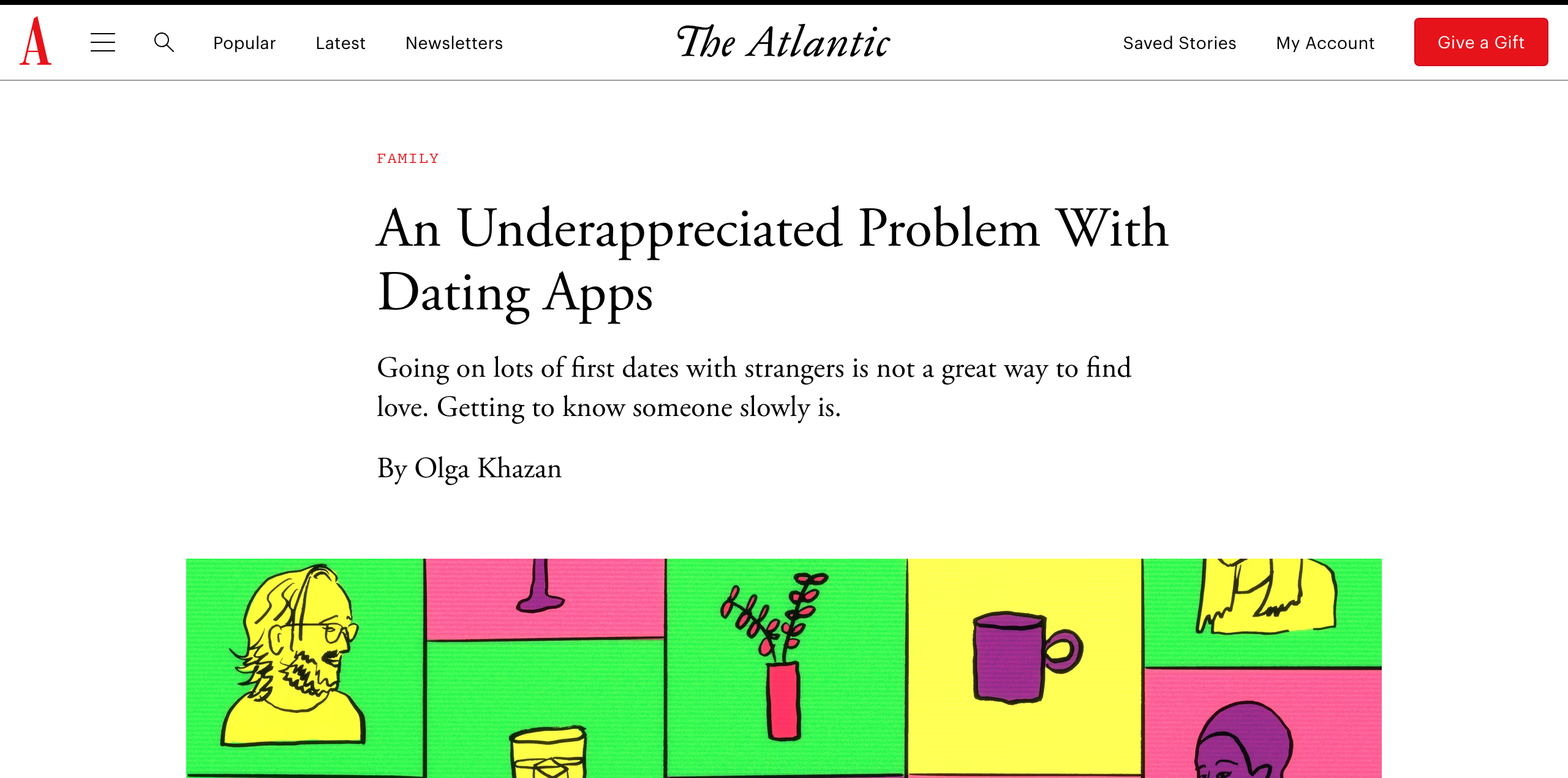
A recent Atlantic article offers a different perspective on dating app problems, but these conditions suggest something more significant.
This article by Olga Khazan shifts the dating app discussion from its products to its approach. Central to such challenges Khazan suggests is the reduction in socializing, especially in “mixed-gender, non-dating” situations.
Dating apps as Khazan describes allow users to filter for hight for example in ways that might make the process more efficient. Such preferences however can be supplanted by other, and more appealing attributes, such as poise under pressure or kindness to strangers, that often and sometimes only appear in repeated interactions over time.
These apps might make looking for love more efficient, but that encourages users to expect perfection as Khazan explains and reduces these experiences to chemistry with strangers rather than affection that arises with context. The more important issue I believe is that these digital matchmakers are no match for human experience.
Human analogues obviously aren’t perfect. Some arrangements whether marriages or something less legal don’t succeed for any substantial time.
This imperfection however is essential. Human relationships more generally not only consist of but also depend upon imperfect experiences, which can be gateways to bigger benefits and more satisfaction.
I’m not suggesting that dating challenges, which others have documented and discussed, can be completely explained by digital difficulties. I do think these conditions though cannot be disentangled from the digital devices and platform technologies that have catalyzed, or at least contributed to, these.
Efficiency more importantly isn’t always an unalloyed good. Not everything is or should or even can be an engineering problem.
Apps and algorithms in other words cannot completely replace human experience and expertise. Some areas of human existence in still other words must be protected from the intrusion of digital technologies, including AI.
And that is something worth remembering for all of us whether we dating or not as we consider first principles for incorporating these technologies, including AI, into our lives.
I was quickly consumed by the new comedy crime thriller Maximum Pleasure Guaranteed but ultimately couldn’t find any significance substance behind the flash, which only confirmed my larger concerns.
Divorced fact-checker Paula (Tatiana Maslany), who is fighting her remarried ex-husband Karl (Jake Johnson) from moving their young daughter Hazel (Nola Wallace) to a different state, is blackmailed by a cam-boy and later witnesses this cam-boy’s murder by his boyfriend. She becomes a suspect after NYPD detectives process the crime scene — she had gone to her blackmailer’s home to confront him — and uncovers in exonerating herself with her co-workers’ help a larger blackmailing scheme.
This streaming series, which is well liked by credible critics, cleverly incorporates contemporary technology and its cultural effects, which is part of its appeal. It also features tech-savvy characters and multiple plot twists, like a Möbius strip, across ten episodes that never exceed forty minutes, which maintains its fast pace.
None of that though prevents its creator David J. Rosen from developing both primary and secondary characters. For example, the often-abrasive ex-husband Karl, who remarried apparently after an affair, plans to relocate to a rural state, and is fighting for custody of their kid, offers to rent an apartment near their new home for his ex-wife Paula, which he believes is compassionate and not as Paula suggests controlling.
Paula as protagonist is clearly complicated, and as convincingly portrayed by Maslany reestablishes some credibility only to reveal herself as manipulative or dishonest or just something other than she seems. This fact-checker offers intriguing and insightful philosophical pretzels, such as the difference between facts and truth in a bathroom conversation with her boss, for nibbling.
These clearly converge in Paula’s courtroom custody hearing testimony. She has been ruthlessly interrogated by the opposing counsel about her online sexual activity for example around her daughter when she reminds that she is the only mother in the courtroom, which contrasts her with Karl’s new wife Mallory (Jessy Hodges), and that she as Hazel’s mother best knows what her daughter needs.
Paula wins, which surprises Karl and quite possibly the rest of us, and she quickly reassembles her life only to have it upended as expected by yet another revelation that fittingly comes in the conclusion, which reinforces the reality that this master manipulator, and not the blackmailing corporation, is the actual, or at least the emotional, center of this story.
This cast of appealing characters does everything it can to cover up for the underdeveloped plot. Its premise — a fact-checking divorcee investigates blackmail better than the NYPD, and a shadowy corporation that offers blackmail as a service — might be satisfying but is ultimately implausible.
Why would this flailing and frenetic single mother be less credible to experienced detectives than the cam-boy’s blubbering boyfriend who is being interviewed by them in an interrogation room, and who is the actual murderer? Why would these off-book employees be inspired by this criminal corporation to establish their own blackmailing schemes?
The combined effect at least for me is a shove from the story into other observations, such as the product placement pattern of Apple devices for Paula and her co-workers and non-Apple devices for others. That made me recognize the ways that digital devices both facilitated and complicated the lives of these characters and by extensions our own, and even the reflection of their affordances in the aesthetic of this streaming series, which was co-produced by Apple Studio and premiered on Apple TV, and other stories.
The extreme pleasure promised in the title comes from its flash that after fading seems superficial and shallow. Perhaps it’s intended to be ironic, and as such illustrates the limits of lives that suspend delayed gratification and seek pleasure at all costs.
If so, then this streaming series could be a commentary about master manipulators that exert control and avoid consequences while everyone else chases the next dopamine hit, which makes us the actual victims. That in the digitally maximal world of today might have death and taxes as our only guarantee.