Category: politics

  • Some Vital Signs

    Some Vital Signs

    Chicago Public Media could be showing encouraging signs of life.

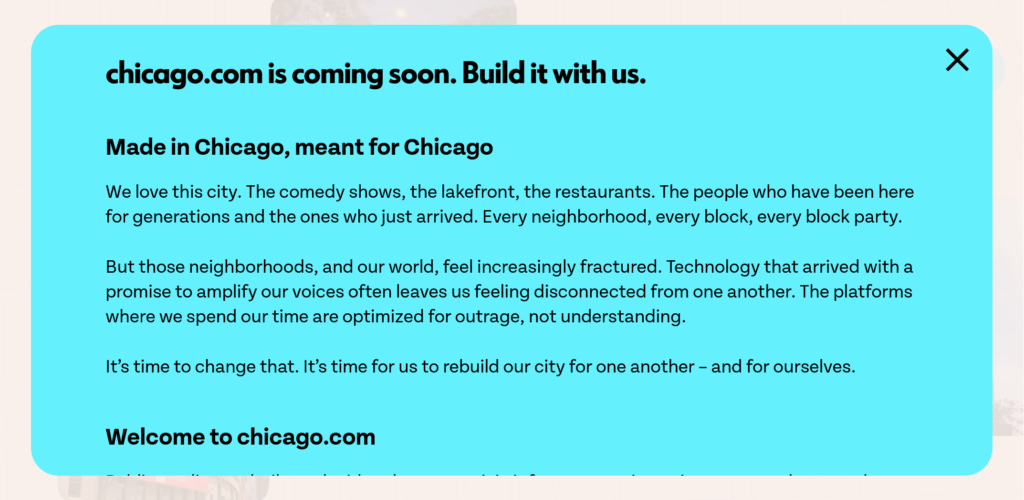
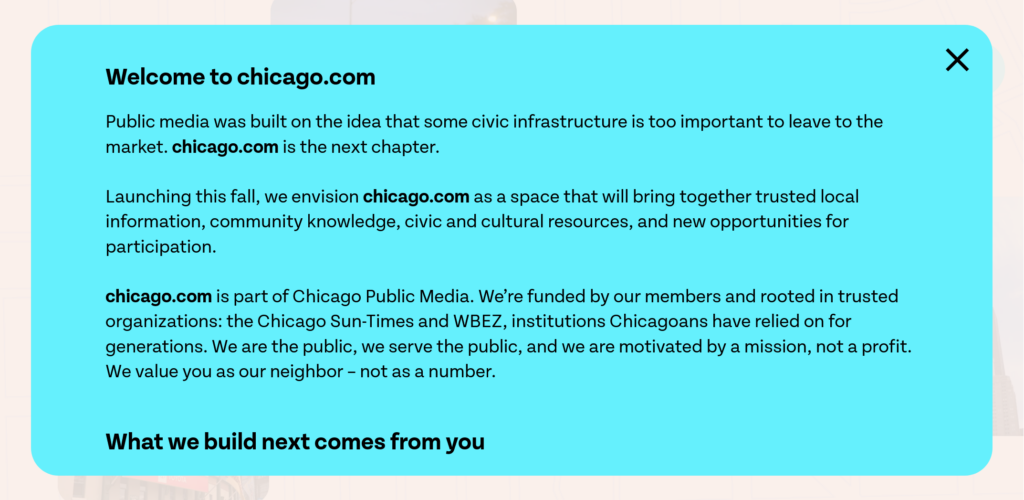
    It recently announced the release of a new website about Chicago for its residents. This space, which reportedly reflects a passion for this city and confronts its fractured communities, is based upon a central public media belief that some “civic infrastructure” cannot come from, and depend upon, the marketplace.

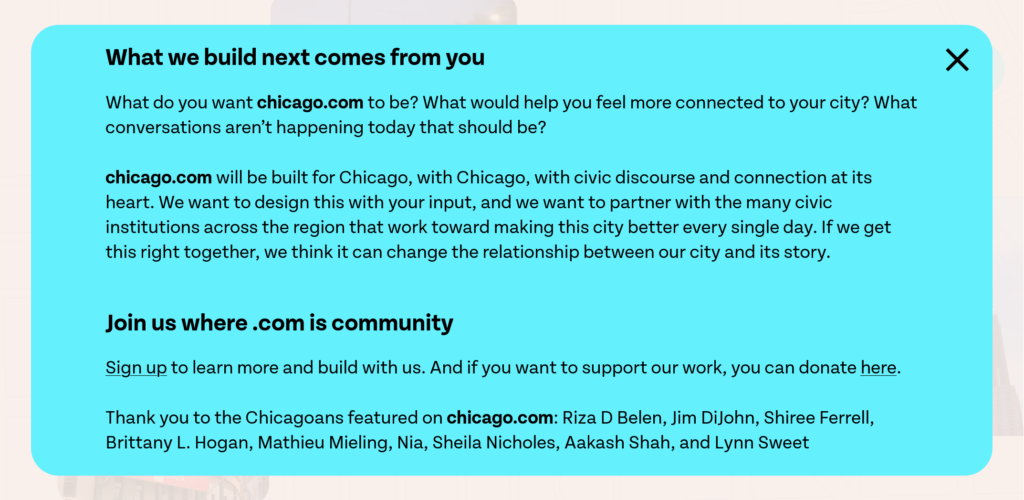
    This site at the moment is basic. It features slick testimonials about the city, a donation link, and a contact form link for those who want to contribute to its development.

    The most exciting element is the link to its rationale, which explains that CPM hopes to offer “trusted local information, communication knowledge, civic and cultural resources, and new opportunities for participation” from its “trusted organizations” — the Chicago Sun-Times and WBEZ. Like these, this new space will be driven not by profit but by the public media mission, and will consider its members not as “number[s]” but as “neighbor[s]”.

    This proposal suggests an awareness of its challenges. However, the proof obviously will be the ways these principles are converted into practices.

    The world has obviously changed, and these changes seem to be accelerating. CPM exists in a world for example where fewer people read newspapers and listen to the radio, and do these if at all online.

    At the same time, the last few years have been challenging. CPM seemed unprepared for instance to integrate the newspaper and to compensate for the predictable federal funding loss.

    Perhaps more challenging has been the inconsistency between its assertions and its actions in small and big ways. Most if not all of these efforts to confront such inconsistencies have been frustratingly ineffective and resulted in maddeningly inadequate responses if any at all.

    Public media are essential, especially in this disinformation era (McQuade 2024, e.g.). Chicago Public Media must retain the best of its previous purposes, such as providing reliable information and curating news stories, and reconfigure its contributions for a fluid future.

    That could go far in restoring my confidence in, and restoring my reduced financial contributions to, this important Chicago institution.

  • Once Again

    Once Again

    Yoni Appelbaum, an Atlantic editor, asks in a recent article about American history in terms of its past and future.

    In it, Appelbaum highlights the need for a “coherent national story” as a way of surviving our politically polarized times. He explains that a more mainstream work-in-progress narrative he reports is contested by a “settler-colonial,” and white supremacy account, which appeals to the left, and a timeless American values version, which appeals to the right. He concludes by reporting that some consider this lack of a shared story as the beginning of the end while others hope that such a possibility will motivate Americans to renew its commitment to a more perfect union.

    Appelbaum’s survey of competing narratives might be a useful way of understanding contemporary political conflicts, but its central insight about the need for a shared perspective isn’t news, or new. Similar observations were offered in the middle of the 1980s culture wars by E. D. Hirsch Jr., who used his literacy research to challenge American education.

    Hirsch, who was alarmed by the state of literacy, confirmed conclusions about comprehension and context. These led him to challenge both educational pluralism, or the common belief that locally-relevant content should be taught in schools, and educational formalism, or the widespread belief that reading, writing, and presumably thinking are skills that can be separated from content.

    Schools instead should teach cultural literacy, or a shared cultural context, especially in English and history that like math and science need a canonical curriculum. Such an approach, which would challenge cultural fragmentation, would also increase students’ reading and writing abilities and even potentially their social participation.

    Hirsch’s perspective has problems. He oversimplifies both the politics of cultural literacy for example and differences among ways of reading, writing, and thinking (i.e., his “linguistic literacy”), which are better understood as cultural practices.

    Nonetheless, Hirsch seems genuinely concerned about a more equitable society. He both recognizes the value of cultural diversity and acknowledges the existence dominant culture without defending it. He also argues that a cultural literacy approach is especially useful to ethnic and economic minorities, who are less likely to be exposed to this dominant culture outside of schools and as a result are more likely to be marginalized and excluded if not introduced to it within schools.

    Hirsch in other words argues for a shared perspective, which he calls cultural literacy and what every American needs to know, as the basis for understanding each other and participating in society. In doing so, he suggests that this perspective, which goes beyond a shared historical narrative, is a challenge he was confronting in the 1980s culture wars that we’re still apparently debating today.

    Hirsch’s account also alludes to a bigger issue. Both Appelbaum and he frame their concerns as American, but Hirsch’s account of his and others’ research suggest that these could quite possibly be human concerns, ones that might be more evident in culturally diverse communities and societies but nonetheless are relevant to human comprehension and communication.

    Shared cultural contexts might be necessary for humans to understand each other and collaborate together, in which case these challenges could be much older, and at the same time ones that our ancestors have managed for millennia.

  • So Long Sun-Times

    So Long Sun-Times

    I’ve discontinued my Chicago Sun-Times subscription, and am disappointed about doing so.

    The final factor was its required “Premium Edition” fee, which for those who had this fee waived is in fact a price increase. These editions are generally useless cash-grabs, and sometimes filled with AI hallucinations. Moreover, this fee is still not required by its cross-town competitor.

    I had switched my daily delivery subscription to the Sun-Times after it was acquired by Chicago Public Media. Since then, I’ve observed a reduction in its quality, such as fewer op-eds and less unique content, that only increases its contrast with its hedge-fund-owned rival.

    I’ve also asked for clarification of inconsistent and inaccurate price-increase processes, missed delivery promises, and subscriber-supporter differences, which are often unclear or even ignored. These issues become even more confusing given that the print newspaper is freely available in .pdf on its website.

    These observations and others, such as the increased content overlap between the Sun-Times and WBEZ or increased sponsor spots on the radio after the predictable federal funding loss, have initiated a seeming commercialized convergence, and produced a cross-platform credibility problem. The limited responses to my often ignored queries from a long-time donor have been less than reassuring.

    I realize that these conditions are part of larger concerns, such as a widespread performative progressivism. Regardless, I think these challenge the primary public media purpose, and its promise of facts and reason for its communities.

    I wonder in other words whether Chicago Public Media is the innovative institution that it describes itself as, and that I’ve long imagined it to be.

    I know that it will continue despite decreases in my modest financial support. I just hope that its leaders can restore my confidence in it as a crucial contributor to an informed Chicago and a functional American democracy.

    Such beliefs are perhaps more important now when hope for our future is harder to find.