I agree with others who assert that Hamnet is a moving movie but wonder whether it works as a story.
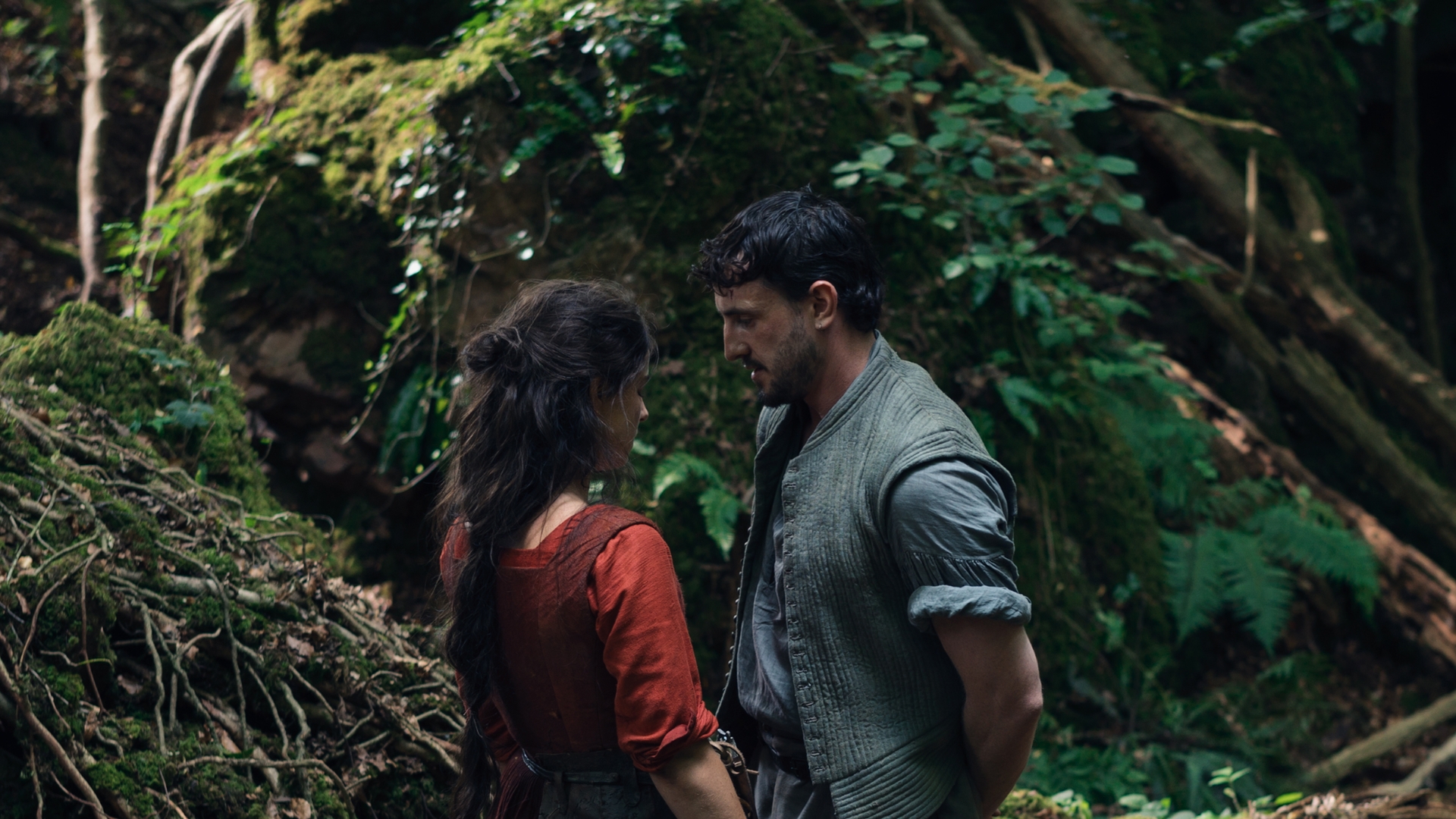
This movie, which offers an account of Shakespeare’s family play, focuses on his wife Agnes (Anne). As such, it becomes in this adaptation of Maggie O’Farrell’s novel by Chloé Zhao and O’Farrell a story about the passion between a reputed forest witch who is alienated from her foster family and a Latin tutor who is repaying his father’s debt.
Agnes (Jessie Buckley) later refuses to join Will (Paul Mescal) in London where she convinced him with her brother’s help to go because she fears for the health of their twin daughter Judith. However, their other twin Hamnet is the one who dies before Will can return, and her grief is compounded when Will returns to London where he develops a different play, which Agnes eventually recognizes as an account of their shared yet different sorrow, and a testament to Will’s love for her.
Such a movie — artists whose work matters more, children who die — usually bores me, but this one has several moving scenes that brought me back to my own relationships, which the best stories often do. Moreover, its direction (Zhao) combines with compelling cinematography (Łukasz Żal) and powerful lead performances to establish an almost mystical mood, and an intoxicating joy, that makes their loss, and its threat to their marriage, all the more moving.
I am most interested in this depiction of the connection that can exist between married couples, and thought it is a compelling corrective to the account of Will’s and Anne’s (Agnes’s) marriage that I had been given in grad school. Little about their lives if memory serves is reliably know, so this fictionalized account is as good in my opinion as any other. Moreover, it refocuses the attention afforded this canonical author, which I’ve never understood, on the relationships that could have sustained and inspired him, and as such serves as a reminder of their significance.
Regardless, I think this movie flirts with melodrama — Agnes inspires both the author of this play and the audience at its premiere — but never makes good on such suggestions until its end. Agnes initially suspects that her son’s memory is being exploited by his father, and her husband, but later realizes that it’s a tribune to his life and their grief.
Agnes is so entranced at its conclusion in part because she discovers that her ability to see visions has been restored. She actually can see her son leave this world and moved into the next one, and she reaches for the hand of the actor who plays Hamlet, and in so doing motivates the entire audience to reach out to him.
That is a powerful scene but also the place where this story unravels at least for me. Will’s motivation while ambiguous is presumably his own existential questions, and that in this account informs Hamlet’s family soliloquy yet never reaches a plausible resolution.
The betrayed in Will’s new play are the son (Hamlet) and his father (King Hamlet), and the betrayer is his mother and the wife (Gertrude). In contrast, Will cannot completely be the betrayer after he was encouraged by Agnes earlier in the movie to establish a London life, and yet Agnes hasn’t quite betrayed Will by insisting upon what she as a mother thinks is best for their sickly twin daughter Judith.
That bothers me more than the misrepresentation of Hamlet’s famous soliloquy, which seems more complicated than the simple contemplation of an existential question that is widely regarded to be. In contrast, I think it’s more a consideration of contingency and chance, and the difficulty in such conditions of defining duty, but such complexity is lost in the oversimplified suggestions of this movie.
Perhaps in the end such scrutiny is unwarranted, and unnecessary. Without it, this movie is the story of a lost woman who finds acceptance and love in someone who would become one of the most famous people in the history of humanity. Who wouldn’t want such romance, especially at this time of the year?
Leave a Reply