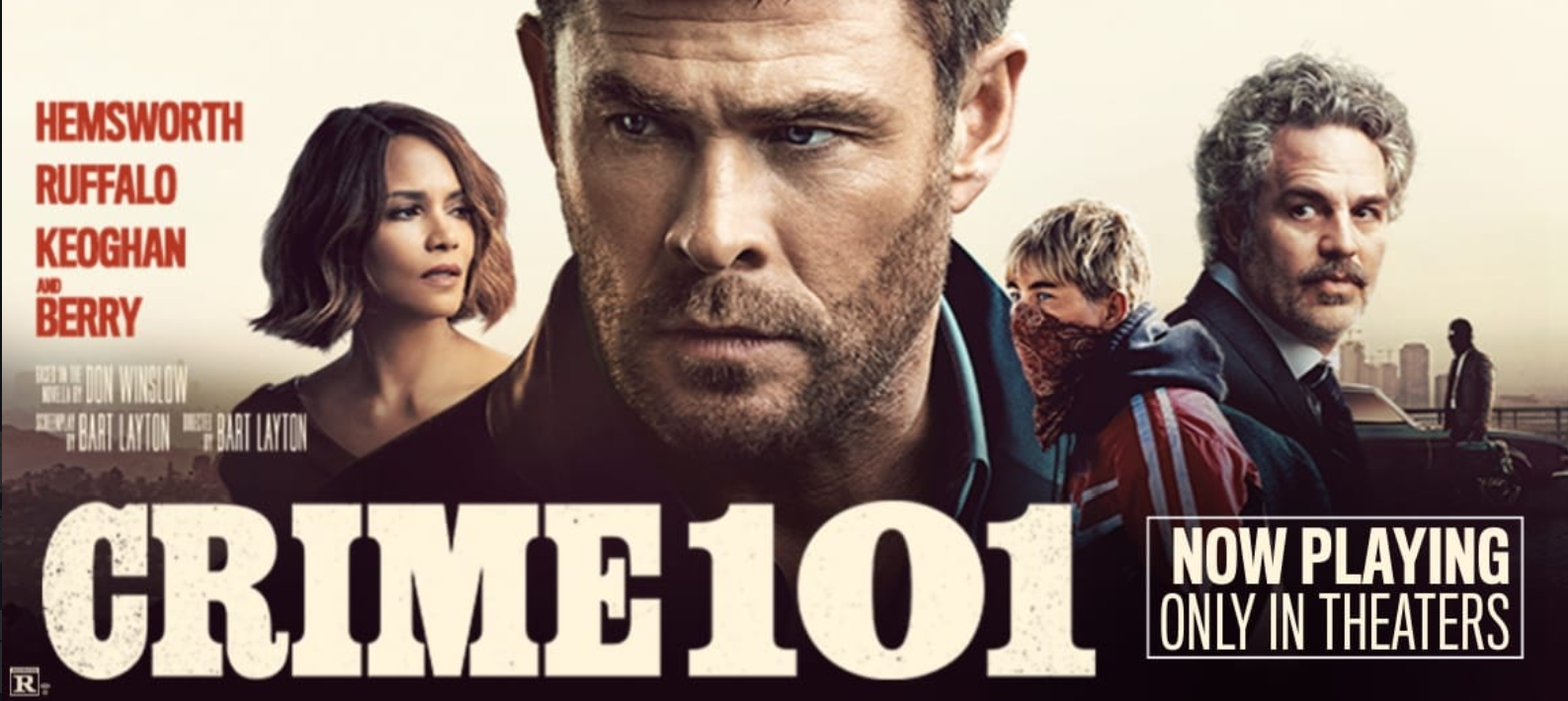
CRIME 101, which has received generally positive reviews, is a search for meaning story confined within a crime caper.
Serial jewelry thief Mike / James Davis (Chris Hemsworth) has rules for his robberies, which he hopes will enable him to amass a predetermined amount of money to compensate for his childhood poverty. He is pursued by Lou Lebesnick (Mark Ruffalo), a seasoned detective who cannot convince his colleagues of the connections among the robberies he is investigating.
These rules explain why Mike cancels his next planned heist, which his fence Money (Nick Nolte) then shares with Ormon (Barry Keoghan). For his next job, Mike needs the assistance of a high-end insurance broker named Sharon (Halle Berry), who feels unappreciated by her boss, especially as she ages.
Mike proposes a dinner date about to Maya (Monica Barbaro) after she crashes her boss’s car at a stoplight into his. Meanwhile, Lou, who has separated from his wife Angie (Jennifer Jason Leigh), is suspended after he refuses to support the false account of another officer’s shooting of an unarmed suspect.
Sharon agrees give Mike insider information but after being assaulted by Ormon turns to Lou, whom she has encountered as a part of his investigation. Lou disrupts Mike’s latest robbery but is surprised by the unexpected arrival of Ormon, who shoots one victim and threatens to shoot Lou, and is then shot and killed by Mike.
Lou offers Mike a cover story, and convinces him to run and the victims to cooperate, and he swaps fake diamonds from one of Mike’s previous robberies for the real ones, which he gives to Sharon for a new life. Lou later discovers the vintage car he has been left by Mike before audiences then learn Maya receives one of Mike’s childhood photos, which seems to be his way of asking for a second chance.
Adapter and director Bart Layton more or less manages the crime thriller conventions and conveys a complicated plot although he needs a lengthy run time to do so. His efforts are supported by mostly convincing performances from the lead actors.
The more impressive accomplishment would have been succeeding at the search for meaning story at the center of this movie. This story, in a more compelling script, could have clarified the connection between Mike and Lou and even them to Sharon and perhaps even Lou’s wife Angie.
The biggest obstacle seems to be the character development. Lou seems underdeveloped, but Sharon is probably too two-dimensional. More development of both could have tipped the balance, and shifted the focus from remunerative illegal activity to the challenges of finding meaning in life.
Lou and Sharon attempted to work within established norms but ultimately reject these, and Mike, who had rejected these norm and manages to escape, only does so at Lou’s mercy. Lou’s moral maturation also benefits Sharon directly, and indirectly even himself.
Such an interpretation suggests that Lou is the center of the underlying story. As it is, the focus is somewhat unclear, and makes this movie at most a semi-satisfying crime caper.
The challenges are an already long running time, which has previously been mentioned, and the limits of Hemsworth’s capacity. Would audiences have engaged even longer? Could he contribute to a more emotionally complex story?
These unanswered questions mean that audiences cannot answer the one suggested by the title — does crime in fact pay? An affirmative answer, which this movie seems to suggest, could require a crime introduction course, or least make it an appealing elective.
Leave a Reply