Tag: Chicago

  • Some Vital Signs

    Some Vital Signs

    Chicago Public Media could be showing encouraging signs of life.

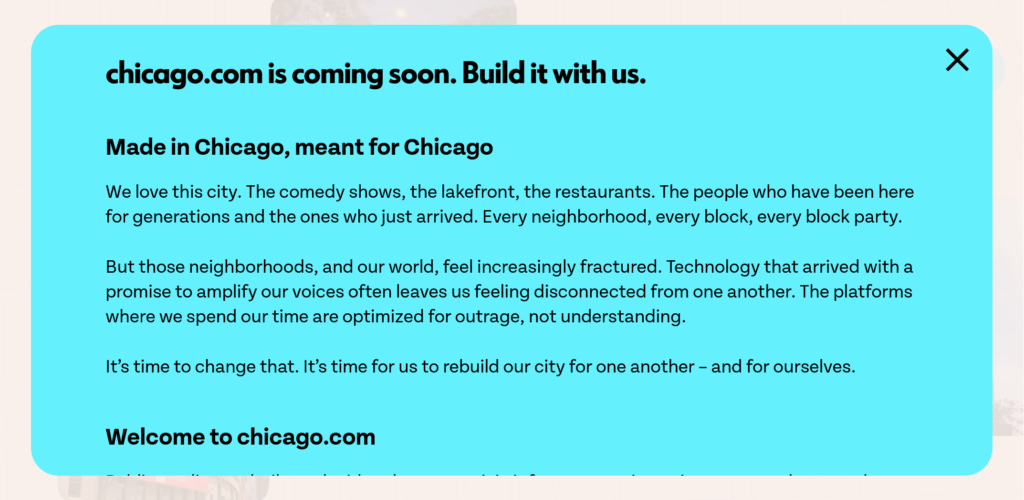
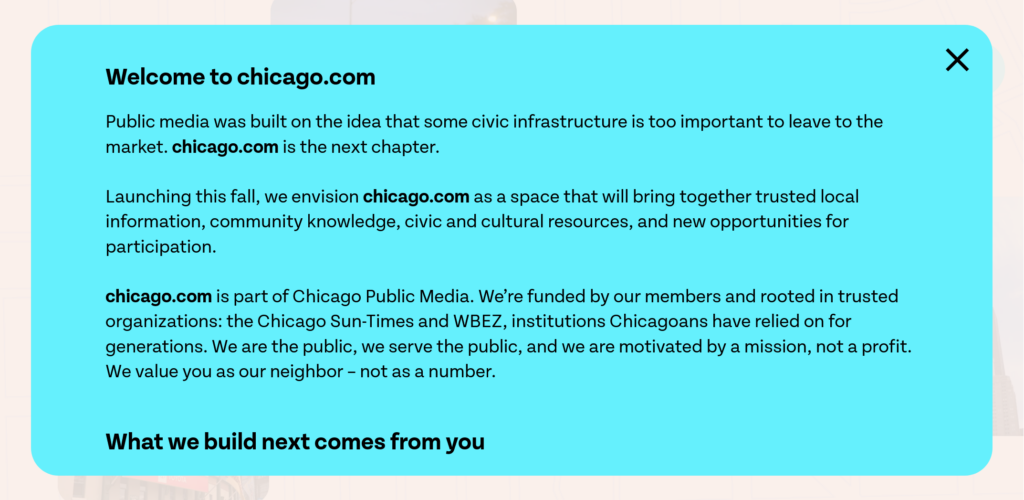
    It recently announced the release of a new website about Chicago for its residents. This space, which reportedly reflects a passion for this city and confronts its fractured communities, is based upon a central public media belief that some “civic infrastructure” cannot come from, and depend upon, the marketplace.

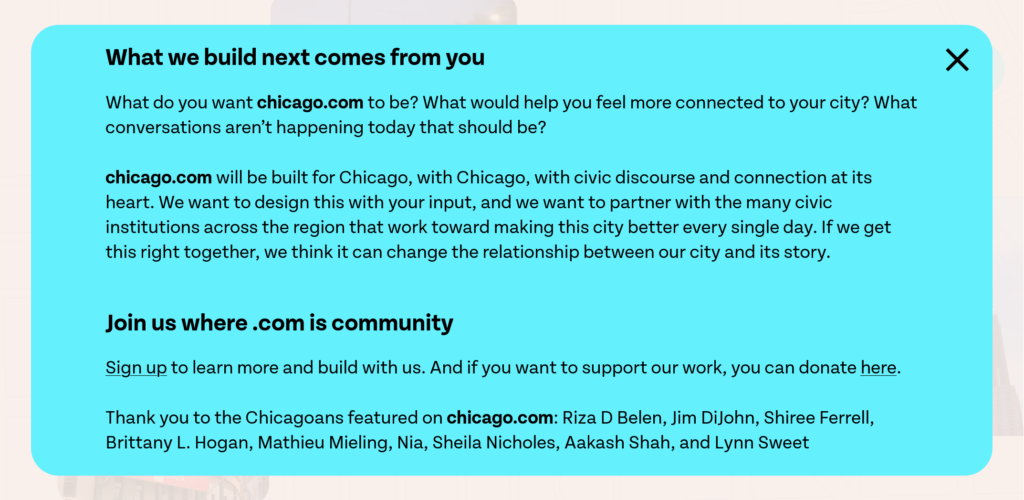
    This site at the moment is basic. It features slick testimonials about the city, a donation link, and a contact form link for those who want to contribute to its development.

    The most exciting element is the link to its rationale, which explains that CPM hopes to offer “trusted local information, communication knowledge, civic and cultural resources, and new opportunities for participation” from its “trusted organizations” — the Chicago Sun-Times and WBEZ. Like these, this new space will be driven not by profit but by the public media mission, and will consider its members not as “number[s]” but as “neighbor[s]”.

    This proposal suggests an awareness of its challenges. However, the proof obviously will be the ways these principles are converted into practices.

    The world has obviously changed, and these changes seem to be accelerating. CPM exists in a world for example where fewer people read newspapers and listen to the radio, and do these if at all online.

    At the same time, the last few years have been challenging. CPM seemed unprepared for instance to integrate the newspaper and to compensate for the predictable federal funding loss.

    Perhaps more challenging has been the inconsistency between its assertions and its actions in small and big ways. Most if not all of these efforts to confront such inconsistencies have been frustratingly ineffective and resulted in maddeningly inadequate responses if any at all.

    Public media are essential, especially in this disinformation era (McQuade 2024, e.g.). Chicago Public Media must retain the best of its previous purposes, such as providing reliable information and curating news stories, and reconfigure its contributions for a fluid future.

    That could go far in restoring my confidence in, and restoring my reduced financial contributions to, this important Chicago institution.

  • The Rest of Us

    I wonder what Stacy Davis Gates thinks of us.

    Gates, who is president of both the Chicago Teachers Union and the Illinois Federation of Teachers, recently argued that CPS is transforming into a “sustainable community school district” of community “anchors” as a result of the recent Chicago Board of Education approved five-year equity plan and four-year union contract. These will produce “the schools our students deserve” and “true community hubs” that reflect local neighborhoods and are “responsible to students and families” within these.

    The CTU and the Board in rejecting previous privatization of education posit schools as spaces of “stability, access and care” that also address larger social problems, such as food deserts and health care gaps. Such schools both “educate young people” and “reflect and uplift entire communities” by extending support beyond classrooms and integrating local needs with learning.

    This Sustainable Community Schools approach, which according to Gates originated in Chicago, has been embraced by other cities. At its center is a concern for students and their families that supports both “personal agency” and community development.

    I’m not surprised that a teachers union president would advocate for schools as central to society. I sometimes wondered as a professor and a parent why what happened in universities where I worked and schools where my kids learned often seemed separate from what happened beyond these institutions.

    I just never assumed that public schools were the only, or even best, ways to care for Chicago students and their families. I knew that private schools do so too as do other initiatives and institutions, such as After School Matters and the Chicago Park District.

    I realized in other words that schools exist within a larger social context. In other words, education while important isn’t everything, and certainly cannot matter more than reliable roads for example or public safety, which also matter, and must be supported, by those of us who call Chicago home.

    Gates in her defense recognized this economic element in acknowledging the need for additional revenue. At the same time, she misrepresents this situation, and denies its difficulty, by describing it as a need for “a fairer tax system” as if such a perception is a citywide consensus even though it clearly is not.

    In fact, the Chicago City Council members (and Illinois legislators) seem unconvinced of the need for a corporate head tax, a property tax increase, and other self-styled “progressive” taxes proposed by the Chicago mayor, a former CPS teacher and CTU-organizer whose election was the result of the CTU support. Moreover, this failure and other challenges to this mayor’s fiscal policies, governing approach, ethical standards, and even political competence could demonstrate the danger of putting educators in charge.

    I would suggest that this this risk can also be seen in Gates herself, and the way she models a progressive hypocrisy that has been convincingly documented by Musa al-Gharbi (2024) among educators and other social elites. For example, Gates has defended her decision to send her son to a private school in what seems like a classic case of public-schools-for-thee-but-not-for-me.

    I’m perhaps as concerned in the end about the effects upon public perceptions of the CTU and unions generally. Gates might be an effective at obtaining results for union members but by overreaching in both this equity plan and union contract risks alienating those who might otherwise be sympathetic to unions.

    The only thing worse than a union, I’ve said, is no union. The better ones I believe recognize their purview and purpose, collaborate with comparable communities, and create coalitions with other constituencies to support shared goals and similar ends, which require a humility that seems scarce in the CTU and its president.

    Reasonable people can disagree on the distribution of funding across public and social services for example or the proper role of schools and education. As a result, these debates need to be ongoing, and relitigated each time budgets are prepared.

    Budgets obviously reflect values, and Chicago, and Illinois, might need to value education more. Neither however can afford to prioritize education over everything else, especially without a citywide consensus, and not just one within CTU.

    These discussions and decisions are difficult, and must be made by those whom all of us have elected, and not educators who have been elected (or bankrolled) by CTU members.

  • Chicago No Kings III

    No Kings Chicago march flyer

    These posters are some of my favorite from the recent No Kings march in Chicago.