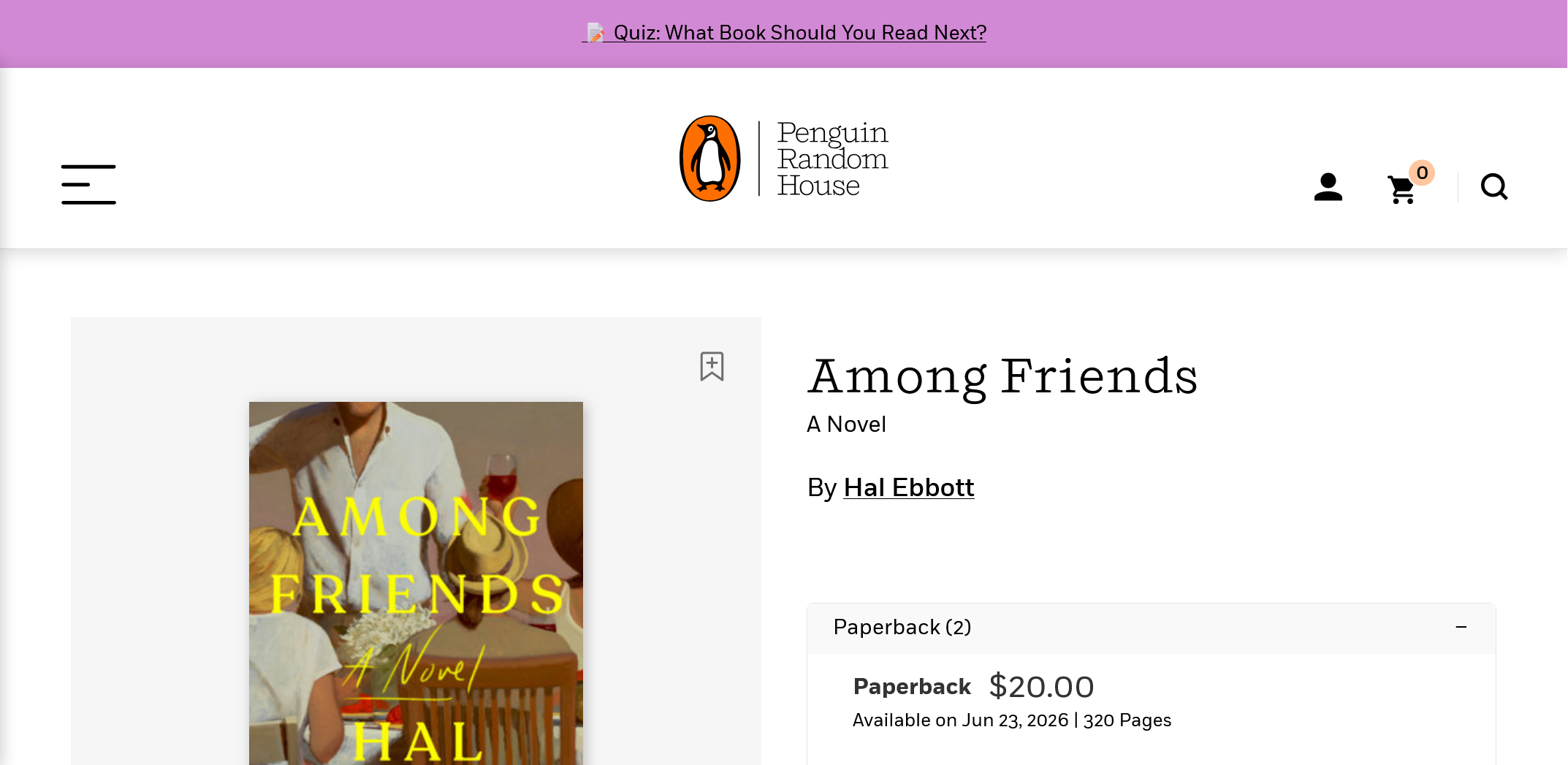
Among Friends by Hal Ebbott is a flawed yet perhaps fascinating novel ostensibly about college friends Emerson and Amos.
Emerson, who introduces Amos to his friend Claire, appears when Amos needs someone, which cements their connection. This connection eventually includes Claire, whom Amos marries, and Emerson’s wife Retsy as well as their respective daughters Anna and Sophie.

The point of view shifts throughout the story, and attempts to establish some sympathy with all of the central characters, but at its center as the title suggests is the connection among the four of them, or at least Emerson, Amos, and Claire. These three are balanced by Retsy, who also counterbalances the pressure added by Claire to the friendship between Amos and Emerson.
Claire, whose history with Emerson at times makes Amos uneasy, displays competing and confusing loyalties throughout the story. Emerson, who assumes that other discuss and even mock him, has an often hidden cruelty that is more revealed than developed.
This cruelty becomes clear to Amos at the end, and catalyzes his change, which is the final focus of the plot and seems to make the novel in the end his story. For most of it, Amos exhibits a relatively uninteresting uncertainty and insecurity, which makes his eventual courage either more moving or less plausible.
This courage comes from nowhere except his empathy for his daughter Anna, and specifically his ability to put her needs ahead of his own. As a result, Amos transforms what until that point had been embarrassing, and has been used against him, which almost redeems his emotional suffering and generates an unexpected strength.
The problem with such an interpretation is the ending, which is too ambiguous and perhaps too rushed. Amos acts independently at the risk of his marriage, and also agrees to Claire’s proposed remedy, which is a family vacation for the three of them that he believes might salvage their marriage.
Amos and Claire however consult Retsy and Emerson for a recommendation even as they intend once there to follow Anna’s direction. That could refer to her preferences for excursions, which is plausible, but doesn’t rule out an invitation to Emerson, Retsy, and Sophie to join them.
This second possibility could portend reconciliation and forgiveness, which seems unrealistic or at the very least an awful possibility. I cannot comment on the proper protocol for such situation — I’m being deliberately vague to avoid revealing too much — and yet am horrified by the prospect of returning to regular interactions among them.
Such an outcome only seems possible, and given the rest of the plot somewhat implausible. If intentional, the novel asks questions about whether we should judge others by their worst moments and if some actions permanently destroy long relationships, in which case the conclusion needs more care, and craft, if only to convince readers that they’re deliberately agitated.
This more generous interpretation would suggest that this story starts as a slow burn only to burst however briefly into a flame, which would be reason enough to read it.