I hoped for more from The Mixed Marriage Project: A Memoir of Love, Race, and Family, which is the most recent book from Dorothy Roberts.
In it, Roberts, who is the George A. Weiss University Professor of Law and Sociology at the University of Pennsylvania, offers an account of the summer she spent in a rented apartment near her Chicago childhood home where she sifted through boxes of her father’s research data, which she was bequeathed after the deaths of both her parents. She reads her father’s interviews of mixed-race married couples and reflects upon discovers about her parents, her younger twin sisters, and herself.
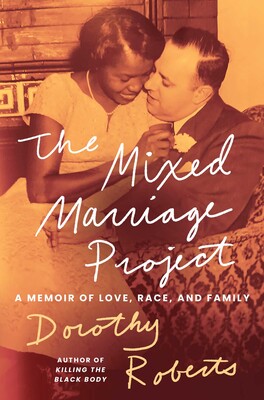
Roberts’s father, who had been a Roosevelt University anthropology professor, began researching black-and-white marriages as a graduate student, and had seemingly been interested in such relationships even longer. For decades, he interviewed such couples, and was regularly assisted by his Jamaican wife Iris, whom he met when she was a Roosevelt student, and later graduate students.
Roberts recalls that family discussions often involved her father’s research, and the book he was continually writing. She learns while reviewing these documents that he had two different contracts for this book for example but had to return both advances because he never completed a manuscript.
Other discoveries seem more significant. For example she hadn’t realized the role that her mother had played in this project or the extent to which her parents’ marriage and even their family could have been part of her father’s research.
These and others motivate Roberts to reconsider her college choice to identify as a black woman, and deny her white father, which could explain her reluctance to acknowledge her personal experience in her lectures and books. She also realizes that her father’s and her lifelong disagreement about race and relationships has been a persistent them in her own speaking and writing.
Her father, who she claims never imposed his belief upon her, maintained that interracial intimacy could overcome racism, and consistently tried to convince her of that. She in contrast maintained that racism would end only when people recognize others of different races as equals, which is a prerequisite she believes for love.
Roberts ultimately reconsiders her perspective, and admits to tempering her resistance to her father’s by the end of the summer. Nonetheless, she is still less hopeful than he, and still convinced of her own account.
Roberts is right I think insofar that this book demonstrates the damage that race as a social construct can do to relationships and families even across generations. Her father for example waited until his mother had died to marry her mother, which then motivated his brother to disown him, and prevented her from meeting her Chicago cousins.
I also admire her candor throughout this book, and appreciate the appeal of confronting her past and understanding its impact upon her present. I additionally can understand the way that this book could be considered the completion of the task her father started but never finished.
Nonetheless, I wonder if Roberts not unlike her father hasn’t quite done so, if she like him still has unfinished business to complete. The reason is that this book seems more like a series of notes about and reflections upon these data and her experiences and less an interpretation and synthesis of these, which are expected of memoirs.
This book clearly has a narrative frame — the summer Roberts spends near her Chicago childhood him reviewing her father’s research data — and an overarching insight — the complication of her race-and-relationships opinion — but needs more perspective if she intends to offer an account of her intellectual and emotional transformation. Perhaps a different organizing principle, or an additional draft, would enable her to complete the task she gave herself.
I’m convinced having been married to a Filipina for thirty years that Roberts like her father has a book here and yet needs more sifting, sorting, and synthesizing to complete it.