Author: Christopher Schroeder

  • More From Our Monsters?

    I was more intrigued by Monsters: A Fan’s Dilemma by Claire Dederer (2023) at its beginning than I was by its end.

    This book is presented as an audience memoir by its author. In it, Dederer considers the question of art created by artists who have behaved badly. She considers a range of different artists, including herself, and she concludes that audiences emotionally respond to whatever moves them, which for her seems sufficient.
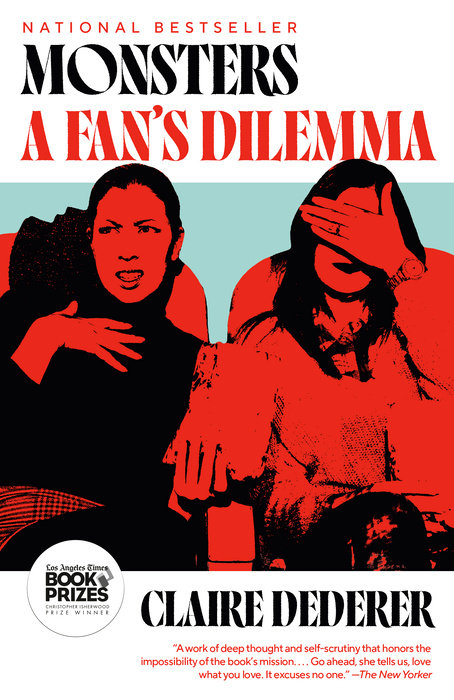
    publisher cover of MONSTERS: A FAN'S DILEMMA by Claire Dederer

    Others readers’ reactions included a debate about the ethics of Dederer’s conclusion and this question. One for example advocated for a distinction between artists who would remuneratively benefit from the consumption of their art, which audiences should avoid, and those who would not, which was acceptable to consume. Another argued for the standards or criteria she had obtained from The Feminist Mystique, which determine her decisions about what, or whose, art to consume even as she was willing to acknowledge the legitimacy of others’ limits.

    Both of these reactions ignore the effects of distribution networks for example and larger social and economic forces that affect whose art is available for consumption or what art certain audiences are expected to consume. Some even so far to argue for the impossibility of ethical consumption in capitalist economies, which could make the more conventional conclusion — art should be separated from artists — that Dederer criticizes the only attractive answer.

    Some reviewers describe this noteworthy and award-winning book, which expands on Dederer’s Paris Review essay, as part memoir and part debate, in which she resists the option of extending her original thesis across hundreds of pages and insists upon repeatedly rethinking her answers to this question. Others suggest it’s more a meditation on the moral ambiguity of this issue that connects the history of artists with the histories of audiences.

    One problem I had was that I expected a wider range of answers, which wouldn’t have precluded Dederer’s conclusion. This expectation is less a criticism of her personalization of this subject, which in retrospect is understandable, as it is a suggestion about its oversimplification, or reduction.

    I also object to her conclusion, which is another problem with this book I have. Such a conclusion allows art consumers to do little more than accept others’ experiences. At most, we can only inquire into others’ interpretive (consumptive?) experiences, or ask how they came to their conclusions about the art they’ve consumed. Such questions are intriguing yet ultimately limited and for me unsatisfying.

    I did appreciate the way this undeniably entertaining book engages its question and its readers, which is an accomplishment. I just wanted more of both.

  • Dead On Arrival

    I repeatedly considered walking out of Dead of Winter, which I think is worse than most credible critics think.

    This movie, which is written by Nicholas Jacobson-Larson and Dalton Leeb and directed by Brian Kirk, is a story about a widow named Barb (Emma Thompson) who is driving in snowstorm to scatter her late husband’s ashes on the lake where they had their first date when she decides to intervene in a kidnapping. The married kidnappers (Marc Menchaca and Judy Greer) hope to extract a kidney from their hostage (Laurel Marsden), who has previously attempted suicide, and are thwarted by Barb, who eventually drags the remaining kidnapper to her, and their, watery death.

    The casting suggests aspirations for something substantial. Thompson in an interview about this movie called for more female heroes presumably of a certain age on the big screen, and suggested that female heroism is existentially essential.

    Thompson isn’t wrong. She just has the wrong project. The scenery-chewing performances make some scenes in this movie difficult to watch, but these only make a flawed script seem worse.

    Barb’s accent might be distracting, but her strength is implausible. This senior citizen can bust through a locked basement door, tumble down a flight of stairs, and exhibit no effects. Elsewhere, she fashions a needle from a fishing hook with one good arm to stich a bullet hole in her other one and later can lift a water heater or some other large appliance high enough to slip her handcuff beneath its leg.

    Her motivation is no more clear than it is for the other characters. Why would Barb for example go to this lake in the middle of a snowstorm, and not wait until it had subsided if not until the ice had thawed? Even their first date — ice fishing when she was much younger — hadn’t occurred in a snow storm.

    Barb’s actions are bewildering. For instance, she has the foresight early in the movie to write backwards on a frosted window to communicate with the young woman who has been imprisoned in the basement, which obviously makes it easier for her to read, but doesn’t think to erase it, which later reveals her presence to the kidnappers.

    Barb decides to spare one of the kidnappers, who has hypothermia after falling into the hole in the lake she cut and hid, after he agrees to drive to the police before the hospital. In response, he donates additional ammo presumably in gratitude for her risky decision or an affirmation of his intentions or both. Barb, who has realized that she needs more bullets, nonetheless fires blindly beneath a vehicle at this kidnapper’s wife, and only strikes her in the leg, which slows but doesn’t stop her.

    Instead, this kidnapper forces Barb to help her take the victim to her makeshift surgical ward atop the icy lake, which happens to be near the fishing cabin Barb had earlier erected. This kidnapper, who has earlier killed her husband after finding him driving away, seems intent upon harvesting her victim’s liver by herself after she also shoots Barb with a rifle in the chest.

    Audience members who circumnavigate these script holes eventually arrive at the final confrontation, which concludes when Barb manages to drag the kidnapper into the same hole where the kidnapper’s husband previously had fallen. We never see the victim who nearly lost her liver try to save her savior, who nonetheless manages to open the tackle tin that had previously saved her life — the bullet is buried in her husband’s ashes — and release these ashes that have been hidden beneath the top layer of lures and line.

    We’ve never learned why this victim had wanted to kill herself or worse why late in the movie she announces a newfound desire to live. We do watch her as the sole survivor discover a photo of Barb and her late husband from her fateful first date years earlier, which mercifully releases us from this cringe-worthy movie.

    Dead might be a B-movie, but that doesn’t absolve it from any and all obligations to its audience.

  • A Little Less Minty

    Mint Mobile is good, and could be great, but just isn’t as good as it once was.

    I’ve been a long-term Mint customer, and have been spending only fifteen dollars a month for my cell service. Moreover, I pay for the entire year, which means I needn’t think about it for twelve months, and more recently have used its family plan for my wife’s service, and appreciate the advantage of a single provider account for both of us.

    One objection however is its eSIM policy, which limits customers to five free every twelve months and then charges three dollars for each subsequent one.

    I swap devices, and could easily do so for the first few years. I’d just power off the device, pop out the SIM, and then slip it into the other.

    This process was even easier with Mint than my previous provider, which required a phone conversation each time. However, it has become more expensive with eSIMs, and as such means that I’m getting less for the same.

    The loss, or cost, could seem trivial and yet still is a loss, and cost, nonetheless. Moreover, it has appeared since I started using the service.

    I could obviously switch service providers, which is something I suspect neither Mint nor I want. I could also restrict device swaps to once every ten to twelve weeks, or just consider the additional fees part of the overall cell service cost, which is probably still cheaper with Mint than other providers.

    I realize that the world in a grander scheme is confronting bigger challenges, which is why I would suggest something this small, and that costs the company so little, could nonetheless seem significant, which could be consistent with its brand as a no-nonsense service provider. Other cell service providers might add fees, Mint could argue, while Mint will not.

    Why not keep long-term customers content, or at least allow them to keep what they’ve always had?