I discovered this week that my seven-day Chicago Sun-Times delivery subscription rate had increased by more than thirty-three percent in one month.
The Sun-Times rep couldn’t explain such a substantial increase, which she insisted had been shared in an email that I couldn’t locate even in my spam folder. She also couldn’t explain how this cost connected to the monthly WBEZ donations that I had been making for many more years than I had been a Sun-Times subscriber.
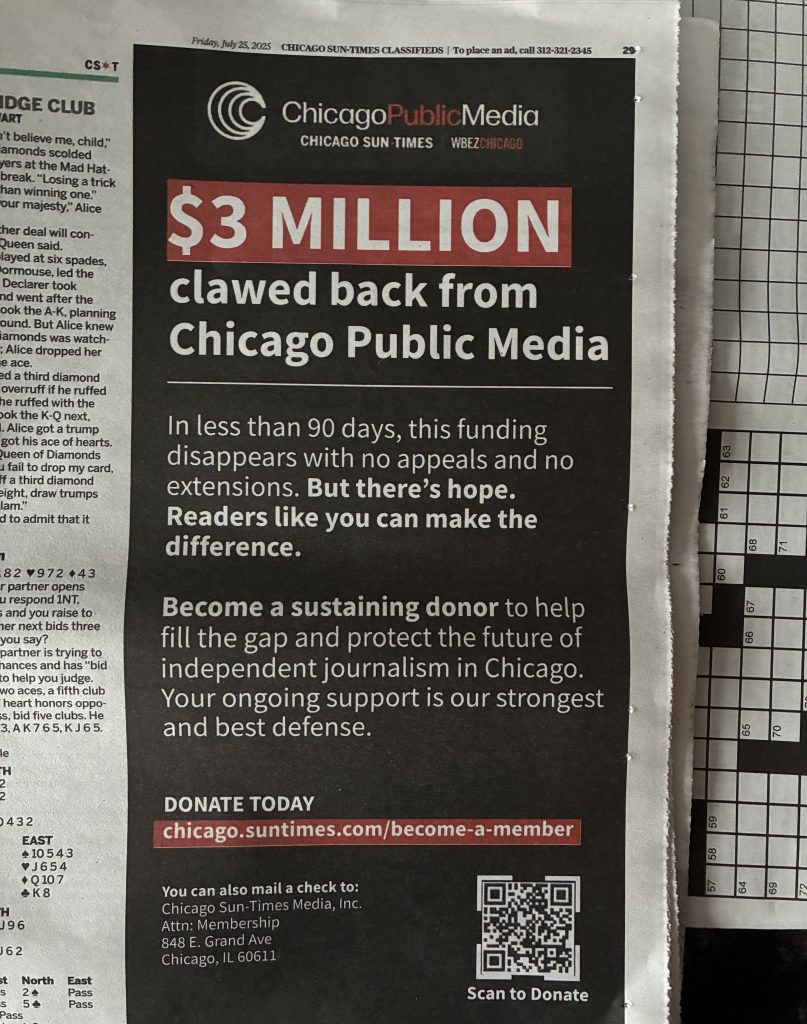
Moreover, this increase was discovered in the same week that WBEZ announced its first on-air WBEZ fundraiser of the year, and the first without federal funding. Both are owned by Chicago Public Media, a nonprofit media company that acquired the newspaper in 2022, which made it “the largest nonprofit local news organization in the nation.”
At that point, I had switched my newspaper subscription from the Chicago Tribune to the Sun-Times in support of public media. I’d generally prefer to have public media funded by the government as it is for example in Canada and elsewhere, which although problematic seems more reliable, but I recognize the political realities in the United States.
One problem is that this new Sun-Times seven-day delivery rate is three times higher than the same Tribune rate at least for new subscribers. Another is that anyone can obtain the entire Sun-Times print version in electronic form through its website without spending any money.
In other words, those of us who support Chicago Public Media, and prefer print newspapers, are spending a minimum of three times more than at least some Tribune subscribers. In exchange, we receive what everyone else can consume without any cost.
A bigger problem is that the Sun-Times and WBEZ content seems to have decreased. Reports I initially hear on the radio for example or read in the newspaper will now reappear in the other form in what seems like a relatively recent overlap.
Even worse is the way that new CPM leaders seemed unprepared for the present reality. They both seemed surprised by the federal funding loss, which is irresponsible given how often it had been threatened over the years, and have offered no coherent vision or detailed mission for its future, including one that explains the part that donors play.
I don’t envy anyone in American public media whose existence depends upon the largesse of public. At the same time, I believe that the present state of public media in the United States could offer an opportunity to reimagine a more independent model, one that is both visionary and inspiring.
If Chicago Public Media did that, they would also suggest that they will be good stewards of our support, which could reassure current donors and motivate new ones.