Michaeleen Doucleff’s (2026) new book Dopamine Kids offers an alternative account of challenges confronting kids and their parents today.
Doucleff, who has a physical chemistry PhD, was surprised to learn that dopamine isn’t a pleasure hormone as it is commonly regarded but a wanting hormone, or one that initiates cravings or urges. For her, this insight explained why would feel worse after acting on urges to surf social media for example or indulge in junk food.
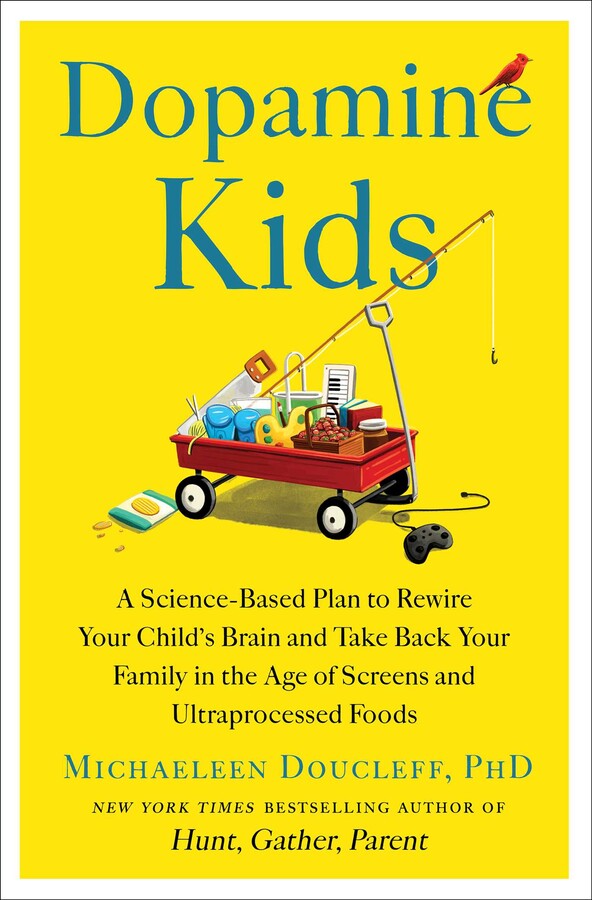
These together form the basis for this book, which is her second one about parenting. In this one, she criticizes the ways digital tech and processed food industries manipulate kids and adults, which she observed in her own home, and offers an account of her efforts, including her research reviews, to change these conditions.
From these, she outlines a process for other parents and people who also want to disrupt their dependencies upon digital technology and processed foods. This process begins with identifying their values, selecting specific alternatives, and reinforcing these replacements and efforts.
Central is recognizing the difference, and often the gap, between wanting and liking. The former figures centrally to the development of cell phone apps for example and snack foods, and is why such changes shouldn’t be seen as will-power problems. Regardless, this distinction Doucleff maintains can be hijacked to support such changes by reconfiguring the connection between these.
Parents in Doucleff’s approach lead these efforts, which requires them to challenge their own choices alongside those of their children. Together, kids and their parents can disrupt their dependencies not by depriving themselves but by replacing these choices with more satisfying ones — closing the gap in other words between wanting and liking — and thus change their homes and their lives.
This book seems to resonate with many reviewers, who like its mixture of personal anecdote, scientific research, and practical processes and strategies. I too appreciated the insight that kids and their parents aren’t surfing social media or eating junk food because these activities make us happy and the suggestion that these changes needn’t result in additional conflict or herculean sacrifices.
I also welcome the inherent challenge that parents must confront their own behaviors and model better ones. I no longer have children at home but think this challenge nonetheless applies for anyone who lives with people whom they love and support.
I struggled with the prominence of the personal experience throughout this book. I can see how it humanizes the author, and could even reduce any sense of superiority or arrogance. Still, I found it excessive at some points and even condescending at others.
I more disliked its unconventional structure, which intersperses principles and practices. I again understand the argument for such an approach. At the same time, I struggled to rehearse the prior reasoning at the outset of the next theoretical, and research, section.
Nonetheless, I think this book was well worth the effort. I wondered before I started it whether it would contain enough insights for someone whose children left years ago, and whose challenges reflect a more senior age group, but I can attest that I certainly got more than I needed and and even more than I hoped.