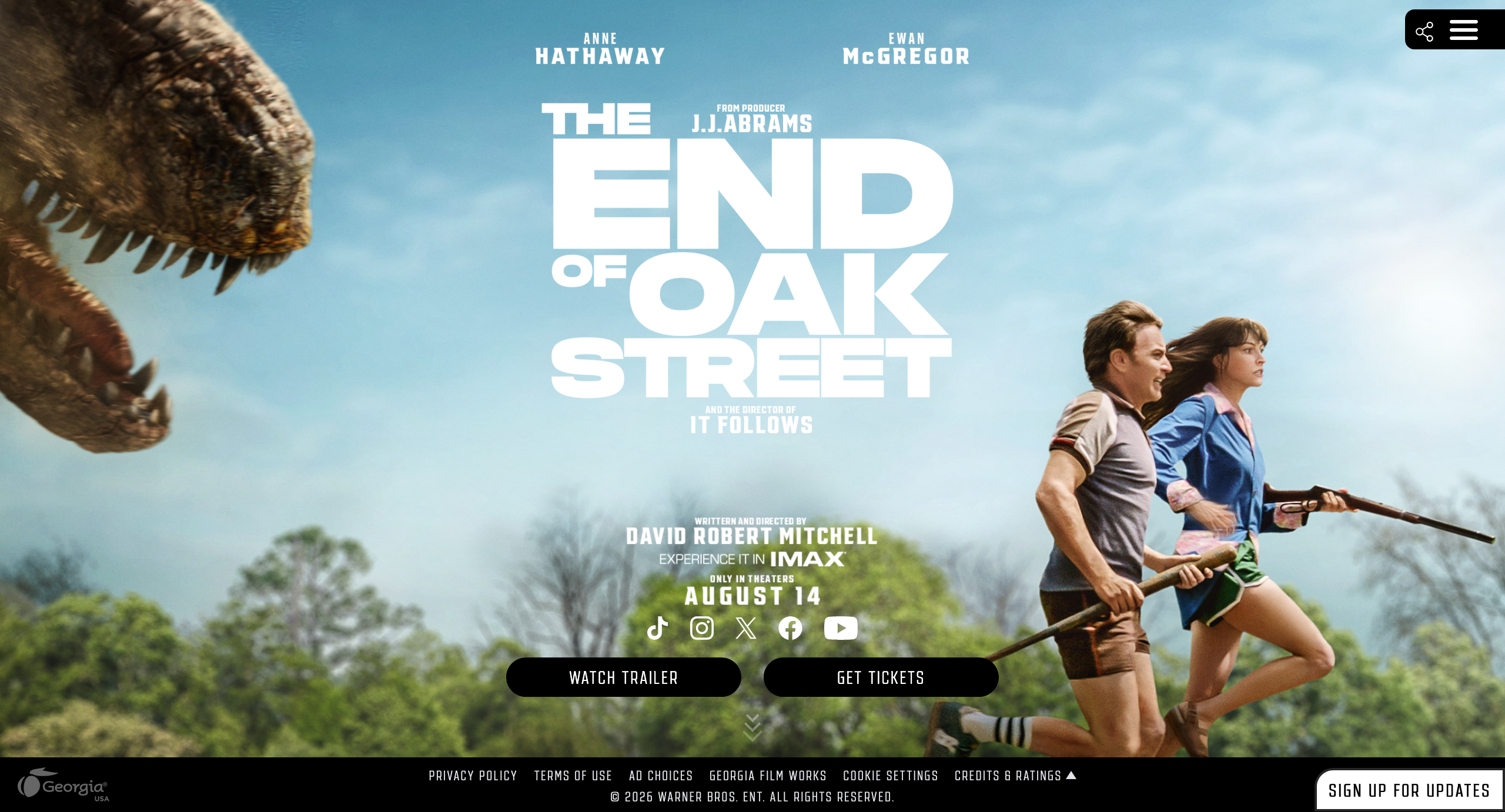
I expected to enjoy The End of Oak Street, as credible critics suggested I would, more than I did.
This movie, which is written and directed by David Robert Mitchell, tells the story of a suburban housewife, and aspiring novelist, named Denise (Anne Hathaway) and her disintegrating marriage to Greg (Ewan McGregor) as their neighborhood is teleported to prehistoric times. Denise must save her children Audrey (Maisy Stella) and Brian (Christian Convery) and their acquaintance Jeannette (Jordan Alexa Davis) by jumping into a shimmering, and blinking, wormhole blob that returns them to their present where she warns, and saves, her husband and neighbors.
I like others was intrigued by the Amblin allusions, such as the suburban adventure and physical effects that appeal to kids and grownups. These were supplemented with thriller conventions more associated with Mitchell, and make me wonder whether the movie was more dystopian than I initially believed.
The effort is an inconsistent tone that for me highlighted awkward performances and stilted scenes. As a result, it wasn’t the “refreshingly, doesn’t care,” and fun, movie that some, such as NPR Pop Cultural Happy Hour host Linda Holmes and her guests, claim it is.
Holmes, who in her accompanying newsletter surveys Mitchell’s previous efforts, argues that he and his cinematographer Mike Gioulakis use experimental techniques without compromising control. As a result, she believes believes that this hybrid action-adventure horror movie, which relies upon a simple structure, a satisfying theme, and a short running time, is intentionally “raucous and silly” with “over-the-top” moments as an entertaining experience that viewers deserve.
I’m unsure how to reconcile this analysis, which seems plausible and persuasive, with the mindless summer entertainment, and more fun in a group, conclusion. Does fun need the neutralization of perception and reflection? What makes this movie any different from other mindless entertainment with which we’re amusing ourselves to death?
The problem isn’t a lack of potential. For example, Denise recounts her experience in a replacement manuscript — her previous one is lost in a basement flood — that is published as a book, and is presumably why her family seems wealthier at the end than they were in the beginning, which raises questions about 1980s intersectionality that are unacknowledged.
The ending in contrast does acknowledge a different problem, and potential. The military has secured Denise’s neighborhood, scientists are investigating wormholes, and Denise’s family hosts a barbecue with Jeannette’s parents and two versions of her.
The second Jeannette, which is presumably a cloned version, is required, or resolved, by the plot. Denise after leaping into the wormhole and returning to their present orders a pizza that Greg delivers — he had been delivering pizzas to Denise’s dismay after he was fired from Chrysler, and her kids and she witnessed his death by dinosaurs in the prehistoric world — and apparently also warns Jeannette’s parents, who seemingly escape with her.
Any residual escapist entertainment evaporated for me the moment two Jeannettes appeared at the barbecue. They however and the others quickly disappear with the end of the movie, which concludes with even more unasked questions.
I suppose that Jeanette’s parents couldn’t be convinced, especially in such a short span of time, to leave her behind. I also suppose that Greg didn’t even consider whether to get the rest of his family because he was delivering pizzas without them, and wasn’t told he was escaping an imminent tragedy.
I enjoy entertainment, and even escapism, as much as anyone. I just resent any time such experiences encourage me to ignore questions, and require me to sacrifice skepticism and relinquish reason, especially while aspiring to be something more substantial.