WBEZ as was predicted held a pop-up fundraiser this week.
This station and National Public Radio have been citing the $1.1 billion loss to their member stations. This money had already been authorized for the Corporation for Public Broadcasting, and included in member station budgets, but Congress at Trump’s request eliminated this funding as a part of its recent recision.
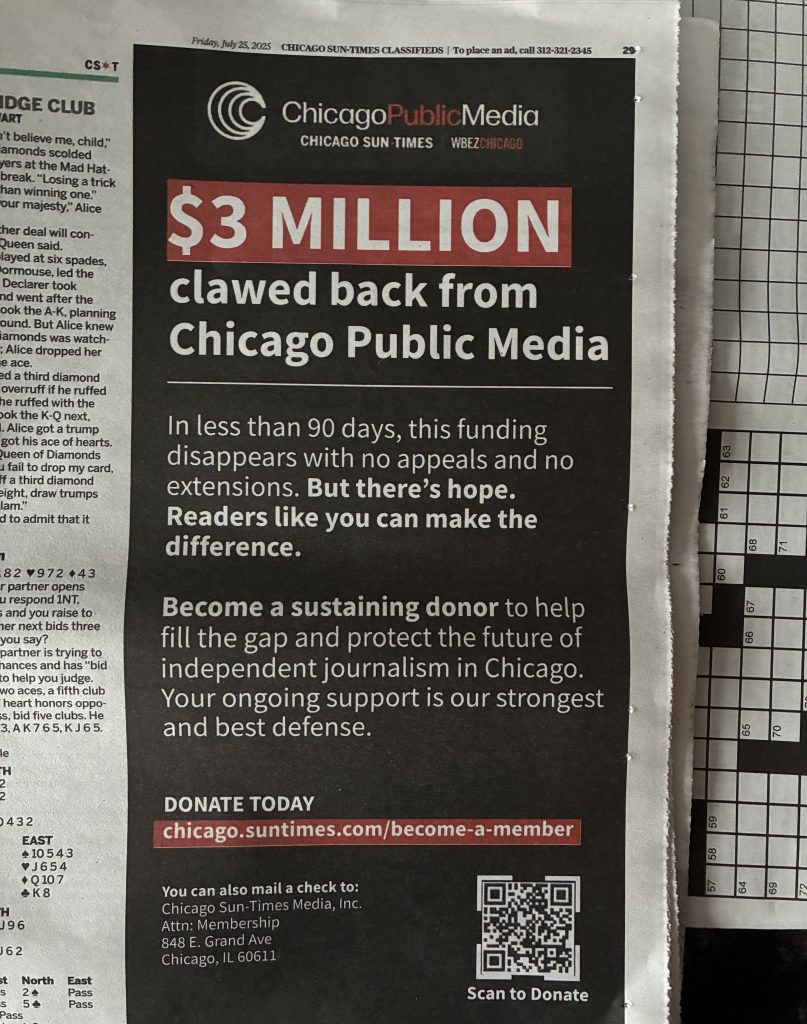
In response, too many public media representatives are talking about losses by focusing on the economic effects. Too few are offering inspiring, imaginative, and innovative visions of the way that public media will continue to exist.
The problem isn’t acknowledging the economic effects, which is understandable. Rather, it’s that only doing so is failing the public at the time it most needs public media.
These cuts have been threatened for years. This attempt increasingly seemed likely to be the one when conservatives withdrew public funding.
Public media representatives in other words have had ample opportunity over many years to envision alternatives, and the worst has happened, which is actually an opportunity. Now is the time to offer an independent and bold vision for the future of public media not just to reassure existing donors but also to attract new supporters.
I would actually welcome a forceful articulation for full public funding (e.g., McChesney 2008). At the very least, I encourage public media leaders to offer bold reimagings of public media today.
Such an approach would transform what the current administration and congressional Republicans expect to be a devastating cost into a potential catalyst for greater independence. As such, it would announce that public media will no longer be dependent upon political whims.
These observations come from a strong public media supporter. My biggest donations for example go to WBEZ, and I switched newspaper subscriptions after Chicago Public Media announced its new partnership with the Chicago Sun-Times newspaper.
That explains my dismay over a recent Sun-Times subscriber survey. This request asked for feedback about which scenarios, such as fewer publication days or less opinion writing, would cause us to cancel our subscriptions.
These seemingly fearful responses offer the wrong, and opposite, message. Public media are needed today perhaps more than ever.
Facts are increasingly threatened. The information environment is increasingly polluted. Reason, deliberation, and other democratic, and American, values are endangered species.
Leading in good times is easier. Leading in challenging times however offers good leaders chances at greatness.
These public media leaders must speak to all of us, including existing donors and the general public. They must encourage us to imagine with them a better public media tomorrow.
That is how I hope we endure the challenges confronting public media today.