Tag: reading

  • More From Our Monsters?

    More From Our Monsters?

    I was more intrigued by Monsters: A Fan’s Dilemma by Claire Dederer (2023) at its beginning than I was by its end.

    This book is presented as an audience memoir by its author. In it, Dederer considers the question of art created by artists who have behaved badly. She considers a range of different artists, including herself, and she concludes that audiences emotionally respond to whatever moves them, which for her seems sufficient.
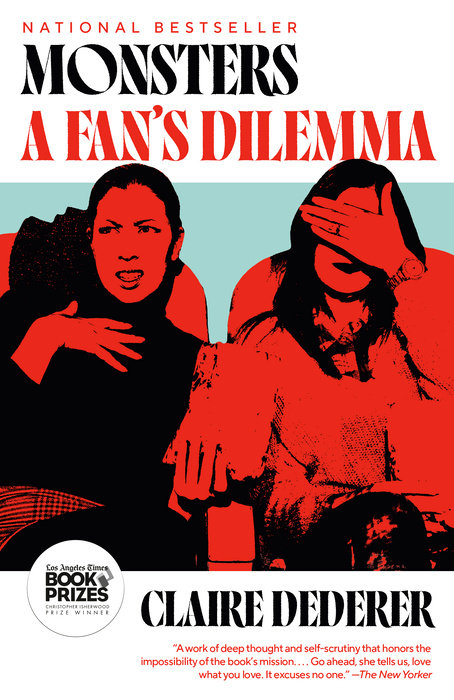
    publisher cover of MONSTERS: A FAN'S DILEMMA by Claire Dederer

    Others readers’ reactions included a debate about the ethics of Dederer’s conclusion and this question. One for example advocated for a distinction between artists who would remuneratively benefit from the consumption of their art, which audiences should avoid, and those who would not, which was acceptable to consume. Another argued for the standards or criteria she had obtained from The Feminist Mystique, which determine her decisions about what, or whose, art to consume even as she was willing to acknowledge the legitimacy of others’ limits.

    Both of these reactions ignore the effects of distribution networks for example and larger social and economic forces that affect whose art is available for consumption or what art certain audiences are expected to consume. Some even so far to argue for the impossibility of ethical consumption in capitalist economies, which could make the more conventional conclusion — art should be separated from artists — that Dederer criticizes the only attractive answer.

    Some reviewers describe this noteworthy and award-winning book, which expands on Dederer’s Paris Review essay, as part memoir and part debate, in which she resists the option of extending her original thesis across hundreds of pages and insists upon repeatedly rethinking her answers to this question. Others suggest it’s more a meditation on the moral ambiguity of this issue that connects the history of artists with the histories of audiences.

    One problem I had was that I expected a wider range of answers, which wouldn’t have precluded Dederer’s conclusion. This expectation is less a criticism of her personalization of this subject, which in retrospect is understandable, as it is a suggestion about its oversimplification, or reduction.

    I also object to her conclusion, which is another problem with this book I have. Such a conclusion allows art consumers to do little more than accept others’ experiences. At most, we can only inquire into others’ interpretive (consumptive?) experiences, or ask how they came to their conclusions about the art they’ve consumed. Such questions are intriguing yet ultimately limited and for me unsatisfying.

    I did appreciate the way this undeniably entertaining book engages its question and its readers, which is an accomplishment. I just wanted more of both.

  • A Need to Read?

    A Need to Read?

    Gloria Edim’s (2024) new memoir is a project in search of a problem.

    The book is a series of thematic chapters loosely organized in chronological order. These offer clusters of experiences, and the ways that reading helped her think through and about these.

    Edim’s claim to fame is the the Well-Read Black Girl organization, which began with a birthday t-shirt from her ex- that enabled her to escape her social isolation and connect with others. She used these casual conversations to launch a book club with friends, which she has developed into an organization that uses storytelling to advocate for social change.

    An account of its origins, and a justification for such a life, might make for relevant reading. The latter could be especially engaging in this era of digital culture, and its attendant challenges to previous justifications for reading, and the humanities.

    The problem is that it never quite gets there. Instead, it focuses more on who Edim has become and how she got there, which is obviously important to her but not necessarily at least as the way these are treated in this book to others.

    A second problem, which emerged after I finished it, is missing information. The timeline is somewhat unclear although I had attributed that to artistic choice. However, it omits details that if included could create challenges at least to the story as presented and promoted in it.

    A good example is her missing father, and he and their subsequent reconnection in Nigeria play prominent parts. However, the book is somewhat unclear that he had previously left for Nigeria, and that her mother and she had reportedly accompanied him when she was younger and frequently visited him, which suggests a somewhat different perspective on for example the house he built there, and left after his death for her brother and her.

    This issue, which is more a challenge for the genre, has little impact on the central limitation. That for me is how books justify their existence, and made this one less satisfying than I expected and hoped.

  • Book Clubbing

    Book Clubbing

    I almost left when the moderator told a newcomer who announced at the outset that she hadn’t actually read the book that doing so isn’t a participation prerequisite.

    This group had been assigned Raw Dog: The Naked Truth About Hot Dogs, by Jamie Loftus (2023). Its publisher insists that it’s a travelogue-culinary history-capitalist critique combo.

    The moderator admitted after I asked that he had chosen it, and had done so before reading it.

    (more…)