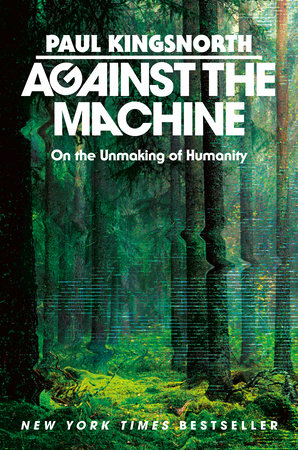
I needed some time to adjust to Paul Kingsnorth’s (2025) latest book Against the Machine and found it useful but ultimately unsatisfying.
Kingsnorth in a seeming synthesis of his thinking criticizes what he calls The Machine and offers what he considers ways to retain our humanity. He considers the emergence of this mindset, which he considers synonymous with the West, and specifically its exchange of place, people, the past, and prayer — the four Ps — for science, the self, sex, and screens, or the four Ss, before suggesting how to respond.
In preparation, he suggests the interrelation of emotion and reason for example and laments the reported loss of a fan’s son to gender reassignment (62-63 and 168-169). He also reports some of his own reactions, such as relocating to the Irish countryside where he plays chess by candlelight and resisting the requirement whereby everyone owns a smartphone (111-113 and 304).
He recommends near the end that readers resist the left-hemisphere approach of the modern mind and develop the ability to attend with the right-hemisphere, which conceives of the world not as a “mechanism” but rather an “organism” (268, 271). He also recommends technological self-control and “reactionary radicalism,” which rejects The Machine moral economy, and its colonization, and endorses one based upon “community bonds, local economies, and human-scale systems” (280).
I appreciate the way Kingsnorth offers a larger context with his account of The Machine. He isn’t satisfied to concentrate on the challenges of artificial intelligence although he does offer an alarming one. Rather, he places digital technologies in a continuum of not just Enlightenment mentalities, the Industrial Revolution, or even the eleventh century Fen Tigers but also “a 1,500-year civilization” of “‘Christendom’” (5).
Such an account is a useful reminder that all technologies emerge and evolve, and that this emergence and evolution are important aspects of understanding their effects and articulating informed responses. Even so, it seems to offer a somewhat selective account that ignores other arguably essential elements of this context.
Digital technologies could be considered for example part of a larger history of technological development, which incudes the invention of literacy for example or farming, that enhances the abilities of humans to trust others and coordinate efforts (Wright 1999, e.g.). Such accounts needn’t ignore the costs Kingsnorth cites or even negate his recommendations, but these could avoid dismissing these developments as completely detrimental.
Nonetheless, this book encouraged me to reconsider my perspective and defend these beliefs, which is certainly welcome and undeniably useful. Moreover, its account of the past and present could be correct, in which case humanity might be in much more trouble than I realize, or want to recognize.
The problem as Kingsnorth admits is that he cannot prove his account although this challenge hasn’t prevented others from attempting to do so (e.g., Pinker 2011 or 2018). At such moments, a better option when offered a range of selections might be opting for a more appealing one, which might not be right but could be more motivating.
That in the end might be the most useful part of this book. For example, it describes shatter zones, including online spaces where we can use The Machine tech to resist its colonization, and distinguishes between raw and cooked barbarians, or those who resist from outside or in-but-not-of The Machine (Kingsnorth 2025, 290-291 and 304-305).
Kingsnorth suggests that cooked barbarians might discover one day that their limits cannot keep them from being poisoned. At such moments, they would have to look for sustenance outside The Machine if they want to live to fight another day.
Such moments could also make some of us wonder whether we’ve been cooked too long.
Leave a Reply