Category: global

  • The Neo Danger

    The MacBook Neo by all accounts is amazing.

    This newest Apple laptop, which consists of MacBook Air compromises for a much more affordable price, has been praised for its performance, build quality, and value. The demand for this “perfect compromise” even surprised Apple, and reportedly contributed to a record number of new customers.

    MacBook Neo website screenshot

    The Neo has few competitors among Windows budget laptops at least at the moment although it could motivate Lenovo for example or HP to improve its offerings. It has next to none among Chromebooks, which are little more than surveillance browsers without the Linux virtual machine option, and still nowhere close with it activated.

    For these and other reasons, the Neo laptop will attract individual users, especially those who already have iPhones and AirPods or Apple Watches but before now couldn’t justify a thousand dollars or more for an Apple laptop. It will also likely have an increased appeal to institutions, such as schools and small businesses, as a result of the same reasons, including the network effect.

    With it, Apple is extending its reach into hardware, which has always been its focus, and adding this extension to its software, platforms (FaceTime, e.g., or iMessage), and services (iCloud, e.g., or Apple TV). As a result, Apple is consolidating its control, and slowly but surely becoming the primary portal through which people access digital networks.

    Such a consolidation challenges adversarial interoperability, or the cooperative potential of different devices and platforms even without the consent. This condition, which has long been considered a threat by Apple, is both central to the invention of the internet (Berners-Lee 2025) and possible remedy to its chronic devolution (Doctorow 2025).

    This consolidation also promotes its colonization of psychological, social, and cultural spaces, which should be increasingly evident. More and more people are walking or worse driving for example while messaging, surfing, or talking as a result of Apple devices. Too many if you ask me seem enthralled with immersion, subjectivity, and other cultural immediacy features that have been promulgated by these devices.

    Some might be more or less alarmed about a human future that increasingly exists within digital networks. Regardless, all of us can be concerned with the way that Apple has positioned itself to exert the greatest control and make the most money, which only compounds its control.

    None of us can dismiss this dependency no matter how much Apple promotes user privacy for example or environmental stability or otherwise presents itself positively to the world. We cannot be confident that it will continue to promote these or other prosocial practices, especially if or when sales start to slump.

    The Apple MacBook Neo in other words might be amazing but upon second thought is also alarming because it contributes to the degradation of digital networks and encourages digital dependency.

    Equally alarming is that such second thoughts might not disqualify the MacBook Neo as my replacement laptop when I need a new one or worse before then.

  • Like Lukewarm Leftovers

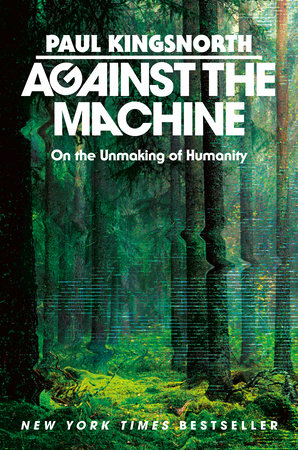
    I needed some time to adjust to Paul Kingsnorth’s (2025) latest book Against the Machine and found it useful but ultimately unsatisfying.

    Kingsnorth in a seeming synthesis of his thinking criticizes what he calls The Machine and offers what he considers ways to retain our humanity. He considers the emergence of this mindset, which he considers synonymous with the West, and specifically its exchange of place, people, the past, and prayer — the four Ps — for science, the self, sex, and screens, or the four Ss, before suggesting how to respond.

    In preparation, he suggests the interrelation of emotion and reason for example and laments the reported loss of a fan’s son to gender reassignment (62-63 and 168-169). He also reports some of his own reactions, such as relocating to the Irish countryside where he plays chess by candlelight and resisting the requirement whereby everyone owns a smartphone (111-113 and 304).

    He recommends near the end that readers resist the left-hemisphere approach of the modern mind and develop the ability to attend with the right-hemisphere, which conceives of the world not as a “mechanism” but rather an “organism” (268, 271). He also recommends technological self-control and “reactionary radicalism,” which rejects The Machine moral economy, and its colonization, and endorses one based upon “community bonds, local economies, and human-scale systems” (280).

    I appreciate the way Kingsnorth offers a larger context with his account of The Machine. He isn’t satisfied to concentrate on the challenges of artificial intelligence although he does offer an alarming one. Rather, he places digital technologies in a continuum of not just Enlightenment mentalities, the Industrial Revolution, or even the eleventh century Fen Tigers but also “a 1,500-year civilization” of “‘Christendom’” (5).

    Such an account is a useful reminder that all technologies emerge and evolve, and that this emergence and evolution are important aspects of understanding their effects and articulating informed responses. Even so, it seems to offer a somewhat selective account that ignores other arguably essential elements of this context.

    Digital technologies could be considered for example part of a larger history of technological development, which incudes the invention of literacy for example or farming, that enhances the abilities of humans to trust others and coordinate efforts (Wright 1999, e.g.). Such accounts needn’t ignore the costs Kingsnorth cites or even negate his recommendations, but these could avoid dismissing these developments as completely detrimental.

    Nonetheless, this book encouraged me to reconsider my perspective and defend these beliefs, which is certainly welcome and undeniably useful. Moreover, its account of the past and present could be correct, in which case humanity might be in much more trouble than I realize, or want to recognize.

    The problem as Kingsnorth admits is that he cannot prove his account although this challenge hasn’t prevented others from attempting to do so (e.g., Pinker 2011 or 2018). At such moments, a better option when offered a range of selections might be opting for a more appealing one, which might not be right but could be more motivating.

    That in the end might be the most useful part of this book. For example, it describes shatter zones, including online spaces where we can use The Machine tech to resist its colonization, and distinguishes between raw and cooked barbarians, or those who resist from outside or in-but-not-of The Machine (Kingsnorth 2025, 290-291 and 304-305).

    Kingsnorth suggests that cooked barbarians might discover one day that their limits cannot keep them from being poisoned. At such moments, they would have to look for sustenance outside The Machine if they want to live to fight another day.

    Such moments could also make some of us wonder whether we’ve been cooked too long.

  • Quite Careless Indeed

    Sarah Wynn-Williams’s (2025) book Careless People is offered as a memoir of her six years at Meta (Facebook), but it focuses as much on the people whose decisions created this company, such as Mark Zuckerberg, Sheryl Sandberg, and Joel Kaplan, who was reportedly hired to appease the Trump administration.

    Wynn-Williams, a former New Zealand diplomat, wanted to work for Facebook she explains because she believed in its potential and its power. She also recognized that this company needed a global perspective to maximize this potential for positive impact, and was eventually offered a position, which she developed in a way that allowed her to become central to its global policies.

    This focus as much as anything explains the emergency injunction won by Meta to prevent Wynn-Williams from promoting her book although that according to some only increased its sales. If so, this response obviously backfired, but that likely means more money for Wynn-Williams but does not increase the likelihood of the public benefits she once identified.

    Wynn-Williams generally knows how to tell engaging stories. Some moments are uneven, but many are engaging. I consistently wondered what happened next, and what some of these powerful yet peculiar people would say or do.

    She also if this account is accurate has admirable attributes, such as confidence, motivation, and resilience. These seem even more so in contrast with her shortcomings that she details, such as the time she stopped in the middle of labor with her feet in the stirrups to draft a requested talking points memo, and insisted despite her husband’s and doctor’s requests upon sending it before returning to the task at hand.

    This and other moments might make some question Wynn-Williams’s judgment. Perhaps most alarming was her willingness to stay in her position despite the political, social, and individual harm, such as blatant sexual harassment, that she witnessed and even experienced. These decisions some could suggest might have condoned such conditions no matter how often she cited the need of her family for health care or any increased capacity to change the company as a company insider.

    Wynn-Williams’s relationship with Meta ends when she is fired. She insists that she had wanted to leave and had been searching for another job, but some might wonder whether she would have ever left on her own volition. Such critics could cite her decision to relocate reportedly at Zuckerberg’s request, which as she admits affects not just her but also her family, or her concerns about the economic consequences if she did.

    Wynn-Williams also offers what could be considered a cautionary tale for those who might still be techno-optimists. She isn’t wrong to imagine the potential power in social media and other digital technologies. At the same time, she depicts the risks of being naive about surveillance capitalism, and especially its ability to disable this potential and exploit users.

    That perhaps is a bigger problem. Despite her engaging stories, she hasn’t provided a narrative. Many moments are engaging although according to some contain little new information, but these together are never quite connected into a sequence of events that ultimately offers useful insight about not just this author but also if readers are lucky the times or world in which we live.

    This flaw can be found even in its title, which refers to Tom and Daisy and their relationship in F. Scott Fitzgerald’s (1925) canonical The Great Gatsby. In it, Tom and Daisy are indeed careless, and even entitled, but Mark, Sheryl, and Joel in contrast seem more than careless, and rather self-absorbed, exploitative, and even ruthless in this book.

    A question I have after reading it is whether Wynn-Williams could be considered part of this problem.