Author: Christopher Schroeder

  • Plagued By Its Own Success

    The Plague, which was officially released on 24 December and nationally available soon thereafter, was good but could have been even better.

    This psychological thriller, which is set in a summer water polo camp, immerses audiences within teenage social dynamics. Ringleader Jake (Kayo Martin) and the other campers act as if Eli’s (Kenny Rasmussen) acne and rash are symptoms of a highly contagious disease that is transmitted through contact. Newcomer Ben (Everett Blunck) wants admission into this group yet increasingly objects to its exclusionary tactics, which has dangerous consequences.

    Author and director Charlie Polinger demonstrates the wisdom of writing what one knows. He reportedly found his old sports camp journals when his mother asked him to sort through the contents of his childhood bedroom where he had been quarantining from COVID ( < > ).

    Both inform his script and direction, which along with the lead performances, cinematography (Steven Breckon) and the score (Johan Lenox) establish an engaging experience for audiences as illustrated by an eleven-minute Cannes standing ovation. In the dark theater, I was transported almost immediately to those days, and remained simultaneously mired in this movie and that muck for most of the time.

    One such recollection included a brother whom I contacted later that night. I omitted this motivation in my message, but wouldn’t have thought of it, or reached out to him, if I hadn’t seen this movie although he never inquired about any of that.

    Nonetheless, I was occasionally distracted by the relative absence of adults except for the coach (Joel Edgerton), who was an unreliable role model. Other adults appeared in loudspeaker announcements in the school for example or the absent part of a phone conversation or were occasionally seen walking through the pool area or eating in the school cafeteria, and were cited in conversations but were otherwise mostly absent.

    The effect is an overpowering account of group dynamics that only relents near the end. Until that point, the movie has been a deep dive into the horrors of teenage group psychology, which is where many remain immersed. Nonetheless, the story seems to succumb to its own pressure almost as if the need to end it surprised its author.

    Perhaps the body-horror violence could be forgiven. Such violence had been foreshadowed, and at least seems potentially plausible. Neither could be said for Ben’s development.

    Ben ostensibly found a way despite challenging circumstances to jump into the deep end and as the coach (Daddy Wags?) advises just be himself. He returns to the coed dance and mimics Eli’s moves, and thus assumes his role. Ben is mostly ignored by the others, which shifts the focus from group dynamics to an individualized, and inconsistent, account.

    The significance is too ambiguous. What would, or could, motivate such a transformation? Or had Ben, who also has a rash, become Eli, and if so, is this rash, and the others’ reactions, symbolize a physical and emotional contagion?

    These unanswered question rather than deepening this experience only made it murkier, which was a disappointing way to end, and leave, this otherwise engaging, and ultimately worthwhile, experience.
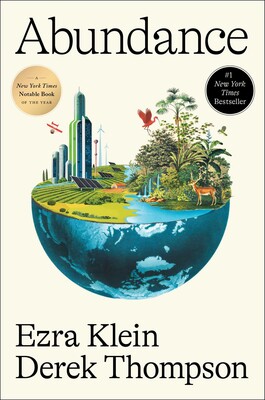
  • Ample Abundance

    Ezra Klein and Derek Thompson (2025) in their recent co-authored book offer an assessment of and an alternative for the American political state of affairs.

    Klein and Thompson criticize both Republicans and Democrats for different and similar reasons. Conservatives for example cannot acknowledge the limits of markets for example and call for small government while embracing large policies. Liberals for instance privilege process over outcomes and embrace political solutions but reject these for their own communities.

    Both more importantly misunderstand the economy and endorse scarcity. A better approach they argue is less concerned with the size of government or the politics of identity and more with capacity and outcomes, and assumes abundance.

    This underlying assumption arises from their observations that substantial changes have slowed and that big ideas are harder to generate. These and other conditions they suggest reflects a general failure to build, invent, and even dream of solutions, which lie at the center of their abundance approach.

    Their perspective as some have noted (e.g., Kazis 2025 or Teachout 2025) is short on specifics. However, such a criticism misunderstands the purpose of this book, which is to critique conventionally liberal perspective, and the larger context in which this exists.

    In this more limited goal, their book seems sufficient. Such an opinion seems validated by others who have used their account to organize regional and national events. Its usefulness even extends to politicians elsewhere, which is an additional endorsement.

    Anything that attempts in other words to account for the sclerotic political present and offer an alternative, and hopeful, future is enough return on the time invested in reading it.

  • Half-Way Is Enough?

    I agree with others who assert that Hamnet is a moving movie but wonder whether it works as a story.

    This movie, which offers an account of Shakespeare’s family play, focuses on his wife Agnes (Anne). As such, it becomes in this adaptation of Maggie O’Farrell’s novel by Chloé Zhao and O’Farrell a story about the passion between a reputed forest witch who is alienated from her foster family and a Latin tutor who is repaying his father’s debt.

    Agnes (Jessie Buckley) later refuses to join Will (Paul Mescal) in London where she convinced him with her brother’s help to go because she fears for the health of their twin daughter Judith. However, their other twin Hamnet is the one who dies before Will can return, and her grief is compounded when Will returns to London where he develops a different play, which Agnes eventually recognizes as an account of their shared yet different sorrow, and a testament to Will’s love for her.

    Such a movie — artists whose work matters more, children who die — usually bores me, but this one has several moving scenes that brought me back to my own relationships, which the best stories often do. Moreover, its direction (Zhao) combines with compelling cinematography (Łukasz Żal) and powerful lead performances to establish an almost mystical mood, and an intoxicating joy, that makes their loss, and its threat to their marriage, all the more moving.

    I am most interested in this depiction of the connection that can exist between married couples, and thought it is a compelling corrective to the account of Will’s and Anne’s (Agnes’s) marriage that I had been given in grad school. Little about their lives if memory serves is reliably know, so this fictionalized account is as good in my opinion as any other. Moreover, it refocuses the attention afforded this canonical author, which I’ve never understood, on the relationships that could have sustained and inspired him, and as such serves as a reminder of their significance.

    Regardless, I think this movie flirts with melodrama — Agnes inspires both the author of this play and the audience at its premiere — but never makes good on such suggestions until its end. Agnes initially suspects that her son’s memory is being exploited by his father, and her husband, but later realizes that it’s a tribune to his life and their grief.

    Agnes is so entranced at its conclusion in part because she discovers that her ability to see visions has been restored. She actually can see her son leave this world and moved into the next one, and she reaches for the hand of the actor who plays Hamlet, and in so doing motivates the entire audience to reach out to him.

    That is a powerful scene but also the place where this story unravels at least for me. Will’s motivation while ambiguous is presumably his own existential questions, and that in this account informs Hamlet’s family soliloquy yet never reaches a plausible resolution.

    The betrayed in Will’s new play are the son (Hamlet) and his father (King Hamlet), and the betrayer is his mother and the wife (Gertrude). In contrast, Will cannot completely be the betrayer after he was encouraged by Agnes earlier in the movie to establish a London life, and yet Agnes hasn’t quite betrayed Will by insisting upon what she as a mother thinks is best for their sickly twin daughter Judith.

    That bothers me more than the misrepresentation of Hamlet’s famous soliloquy, which seems more complicated than the simple contemplation of an existential question that is widely regarded to be. In contrast, I think it’s more a consideration of contingency and chance, and the difficulty in such conditions of defining duty, but such complexity is lost in the oversimplified suggestions of this movie.

    Perhaps in the end such scrutiny is unwarranted, and unnecessary. Without it, this movie is the story of a lost woman who finds acceptance and love in someone who would become one of the most famous people in the history of humanity. Who wouldn’t want such romance, especially at this time of the year?