Yoni Appelbaum, an Atlantic editor, asks in a recent article about American history in terms of its past and future.
In it, Appelbaum highlights the need for a “coherent national story” as a way of surviving our politically polarized times. He explains that a more mainstream work-in-progress narrative he reports is contested by a “settler-colonial,” and white supremacy account, which appeals to the left, and a timeless American values version, which appeals to the right. He concludes by reporting that some consider this lack of a shared story as the beginning of the end while others hope that such a possibility will motivate Americans to renew its commitment to a more perfect union.
Appelbaum’s survey of competing narratives might be a useful way of understanding contemporary political conflicts, but its central insight about the need for a shared perspective isn’t news, or new. Similar observations were offered in the middle of the 1980s culture wars by E. D. Hirsch Jr., who used his literacy research to challenge American education.
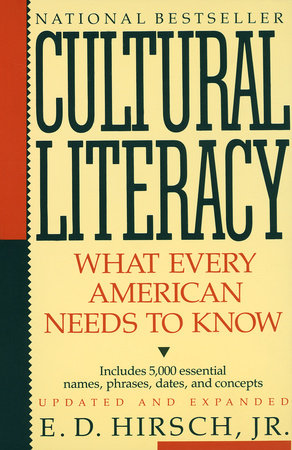
Hirsch, who was alarmed by the state of literacy, confirmed conclusions about comprehension and context. These led him to challenge both educational pluralism, or the common belief that locally-relevant content should be taught in schools, and educational formalism, or the widespread belief that reading, writing, and presumably thinking are skills that can be separated from content.
Schools instead should teach cultural literacy, or a shared cultural context, especially in English and history that like math and science need a canonical curriculum. Such an approach, which would challenge cultural fragmentation, would also increase students’ reading and writing abilities and even potentially their social participation.
Hirsch’s perspective has problems. He oversimplifies both the politics of cultural literacy for example and differences among ways of reading, writing, and thinking (i.e., his “linguistic literacy”), which are better understood as cultural practices.
Nonetheless, Hirsch seems genuinely concerned about a more equitable society. He both recognizes the value of cultural diversity and acknowledges the existence dominant culture without defending it. He also argues that a cultural literacy approach is especially useful to ethnic and economic minorities, who are less likely to be exposed to this dominant culture outside of schools and as a result are more likely to be marginalized and excluded if not introduced to it within schools.
Hirsch in other words argues for a shared perspective, which he calls cultural literacy and what every American needs to know, as the basis for understanding each other and participating in society. In doing so, he suggests that this perspective, which goes beyond a shared historical narrative, is a challenge he was confronting in the 1980s culture wars that we’re still apparently debating today.
Hirsch’s account also alludes to a bigger issue. Both Appelbaum and he frame their concerns as American, but Hirsch’s account of his and others’ research suggest that these could quite possibly be human concerns, ones that might be more evident in culturally diverse communities and societies but nonetheless are relevant to human comprehension and communication.
Shared cultural contexts might be necessary for humans to understand each other and collaborate together, in which case these challenges could be much older, and at the same time ones that our ancestors have managed for millennia.
Leave a Reply