Tag: books

  • The Dope on Kids and Their Parents Today

    The Dope on Kids and Their Parents Today

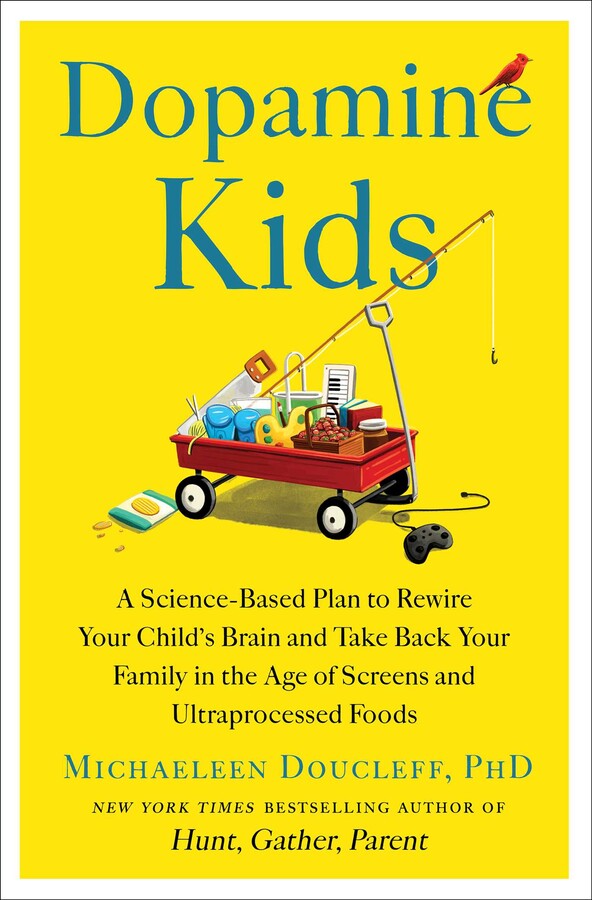
    Michaeleen Doucleff’s (2026) new book Dopamine Kids offers an alternative account of challenges confronting kids and their parents today.

    Doucleff, who has a physical chemistry PhD, was surprised to learn that dopamine isn’t a pleasure hormone as it is commonly regarded but a wanting hormone, or one that initiates cravings or urges. For her, this insight explained why would feel worse after acting on urges to surf social media for example or indulge in junk food.

    These together form the basis for this book, which is her second one about parenting. In this one, she criticizes the ways digital tech and processed food industries manipulate kids and adults, which she observed in her own home, and offers an account of her efforts, including her research reviews, to change these conditions.

    From these, she outlines a process for other parents and people who also want to disrupt their dependencies upon digital technology and processed foods. This process begins with identifying their values, selecting specific alternatives, and reinforcing these replacements and efforts.

    Central is recognizing the difference, and often the gap, between wanting and liking. The former figures centrally to the development of cell phone apps for example and snack foods, and is why such changes shouldn’t be seen as will-power problems. Regardless, this distinction Doucleff maintains can be hijacked to support such changes by reconfiguring the connection between these.

    Parents in Doucleff’s approach lead these efforts, which requires them to challenge their own choices alongside those of their children. Together, kids and their parents can disrupt their dependencies not by depriving themselves but by replacing these choices with more satisfying ones — closing the gap in other words between wanting and liking — and thus change their homes and their lives.

    This book seems to resonate with many reviewers, who like its mixture of personal anecdote, scientific research, and practical processes and strategies. I too appreciated the insight that kids and their parents aren’t surfing social media or eating junk food because these activities make us happy and the suggestion that these changes needn’t result in additional conflict or herculean sacrifices.

    I also welcome the inherent challenge that parents must confront their own behaviors and model better ones. I no longer have children at home but think this challenge nonetheless applies for anyone who lives with people whom they love and support.

    I struggled with the prominence of the personal experience throughout this book. I can see how it humanizes the author, and could even reduce any sense of superiority or arrogance. Still, I found it excessive at some points and even condescending at others.

    I more disliked its unconventional structure, which intersperses principles and practices. I again understand the argument for such an approach. At the same time, I struggled to rehearse the prior reasoning at the outset of the next theoretical, and research, section.

    Nonetheless, I think this book was well worth the effort. I wondered before I started it whether it would contain enough insights for someone whose children left years ago, and whose challenges reflect a more senior age group, but I can attest that I certainly got more than I needed and and even more than I hoped.

  • Like Lukewarm Leftovers

    Like Lukewarm Leftovers

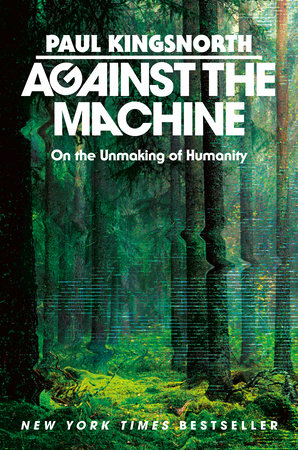
    I needed some time to adjust to Paul Kingsnorth’s (2025) latest book Against the Machine and found it useful but ultimately unsatisfying.

    Kingsnorth in a seeming synthesis of his thinking criticizes what he calls The Machine and offers what he considers ways to retain our humanity. He considers the emergence of this mindset, which he considers synonymous with the West, and specifically its exchange of place, people, the past, and prayer — the four Ps — for science, the self, sex, and screens, or the four Ss, before suggesting how to respond.

    In preparation, he suggests the interrelation of emotion and reason for example and laments the reported loss of a fan’s son to gender reassignment (62-63 and 168-169). He also reports some of his own reactions, such as relocating to the Irish countryside where he plays chess by candlelight and resisting the requirement whereby everyone owns a smartphone (111-113 and 304).

    He recommends near the end that readers resist the left-hemisphere approach of the modern mind and develop the ability to attend with the right-hemisphere, which conceives of the world not as a “mechanism” but rather an “organism” (268, 271). He also recommends technological self-control and “reactionary radicalism,” which rejects The Machine moral economy, and its colonization, and endorses one based upon “community bonds, local economies, and human-scale systems” (280).

    I appreciate the way Kingsnorth offers a larger context with his account of The Machine. He isn’t satisfied to concentrate on the challenges of artificial intelligence although he does offer an alarming one. Rather, he places digital technologies in a continuum of not just Enlightenment mentalities, the Industrial Revolution, or even the eleventh century Fen Tigers but also “a 1,500-year civilization” of “‘Christendom’” (5).

    Such an account is a useful reminder that all technologies emerge and evolve, and that this emergence and evolution are important aspects of understanding their effects and articulating informed responses. Even so, it seems to offer a somewhat selective account that ignores other arguably essential elements of this context.

    Digital technologies could be considered for example part of a larger history of technological development, which incudes the invention of literacy for example or farming, that enhances the abilities of humans to trust others and coordinate efforts (Wright 1999, e.g.). Such accounts needn’t ignore the costs Kingsnorth cites or even negate his recommendations, but these could avoid dismissing these developments as completely detrimental.

    Nonetheless, this book encouraged me to reconsider my perspective and defend these beliefs, which is certainly welcome and undeniably useful. Moreover, its account of the past and present could be correct, in which case humanity might be in much more trouble than I realize, or want to recognize.

    The problem as Kingsnorth admits is that he cannot prove his account although this challenge hasn’t prevented others from attempting to do so (e.g., Pinker 2011 or 2018). At such moments, a better option when offered a range of selections might be opting for a more appealing one, which might not be right but could be more motivating.

    That in the end might be the most useful part of this book. For example, it describes shatter zones, including online spaces where we can use The Machine tech to resist its colonization, and distinguishes between raw and cooked barbarians, or those who resist from outside or in-but-not-of The Machine (Kingsnorth 2025, 290-291 and 304-305).

    Kingsnorth suggests that cooked barbarians might discover one day that their limits cannot keep them from being poisoned. At such moments, they would have to look for sustenance outside The Machine if they want to live to fight another day.

    Such moments could also make some of us wonder whether we’ve been cooked too long.

  • Making the Most

    Making the Most

    I can understand the appeal of Olga Dies Dreaming by Xochitl Gonzalez as the 2025 One Book One Chicago selection but nonetheless wanted more.

    This 2022 novel, which is Gonzalez’s first, tells the semi-autobiographical story of a wedding planner named Olga along with her politician brother Prieto as they confront in their adult lives an absent mother who prefers political activism and a late father who as an addict died from AIDS. It’s the first in what Gonzalez calls a Brooklyn trilogy — the second, which was published in 2024, is Anita De Monte Laughs Last, and the third, which will be released this spring, is Last Night in Brooklyn, and reportedly includes familiar characters, such as Olga’s boyfriend Matteo.

    Chicago Public Library Commissioner Chris Brown told the keynote event audience that Gonzalez is the first Puerto Rican author to be selected in the twenty-five years of the One Book One Chicago program, which is obviously appealing. Puerto Ricans, who initially came to Chicago from New York in the 1930s, have been central to the city (e.g., Barrio Borikén) and the country (e.g., the Young Lords).

    Gonzalez’s first novel definitely draws upon her ethnic identity, or at least her mother’s contribution — she is also Mexican-American from her father’s side although she was raised by her maternal grandparents. Gonzalez actually wanted to write a book about Puerto Rico and colonialism but decided to make such a book more accessible, and more appealing, as a novel.

    Another appeal could be the way it resembles at times a telenovela. Such stories, which might be less prominent in Puerto Rico than for example Mexico, can be widely found, and thus familiar. These telenovela conventions can be recognized in the lost-and-found love or the feuding-mothers-and-daughters themes for example or the fairytale-like ending for both Olga and Prieto.

    Both aspects for me are partly why I wanted more. Gonzalez, or her editor, seems unaware of the sections or scenes, such as the letters from Olga’s mother Blanca or a conversation between Olga and her ex-boyfriend Reggie, that seem more like political primers or even mansplaining. Moreover, the conclusion seemed too inconsistent, and too convenient, after conflicts confronted by Olga, Prieto, and others, such as Matteo.

    Other readers at least at the One Book One Chicago events I attended had more to say about these characters than the plot. None at one for example seemed to agree that this novel is an older woman’s coming-of-age story, which its publisher suggests is its primary appeal. Such an account would also be consistent with the title, and the allusion to “Puerto Rican Obituary” Olga, who “dies dreaming of a five dollar raise” in a powerful poem by Pedro Pietri.

    This Olga doesn’t die, but her evolution is unclear, and ultimately unbelievable. How mature was she if in late in the story she is willing to use her sexuality to exploit her wealthy, and ex-boyfriend, Dick to help Blanca’s political goals, especially when she knows about Matteo’s concerns about trust and abandonment? What happens after the assault that convinces her at the end to bail on her plan to snitch anonymously on her mother’s political activities?

    These limitations loom larger in the context of other characters, such as Olga’s Tita Lola who collaborates with Olga’s cousin Mabel to expose Blanca’s perfidy. So where was Tita Lola when Olga was relying upon Blanca’s surrogate, and best friend, Karen? And why wouldn’t Tita Lola have been at least some support for Prieto as he confronted his sexuality, especially when his secrets made him even more vulnerable?

    I would be more chagrined if my dissatisfaction were merely the quality of this selection, which would be embarrassingly stereotypical. Rather, I wonder about this selection in regards to the dual One Book One Chicago goals of enlightening Chicagoans and creating community.

    One enlightenment possibility could be the way that Olga and Prieto grapple with their diasporic cultural identity. Such syncretic identities based upon my observations can be quite complicated, and certainly relevant to many Chicagoans, and this novel could offer insights that never quite materialize. Neither however seems to understand even at its end what they think being Nuyorican means or even committed to continue coming to terms with it.

    Some readers I admit connected with this theme in this book. Several acknowledged in a discussion group I co-moderated for example that this selection made them think about resistance in South Korea from where they had emigrated. That however seemed less from anything in the book and more from the thoughtfulness these readers brought to it.

    Community I suppose can come from any shared reading with the right readers even if they agree on the limitations of such a text, which was certainly a minority opinion. At a discussion, my co-moderator gave it the highest rating for example while I offered a more middling one.

    I know that choosing a One Book One Chicago selection is challenging. I also believe that my collaboration with those who administer this program has been perhaps the most significant service in my opinion of my academic career, and something I hope to continue even after retiring.

    Perhaps that passion produces unrealistic expectations, which could be why this otherwise appealing selection seemed disappointing.