Tag: Chicago Sun-Times

  • Texts Today

    I’ve had my issues with the Chicago Sun-Times, but I’m objecting this time to recent comments from one of its writers.

    Sun-Times columnist Neil Steinberg wrote one that was ostensibly about why Chicago Children’s Museum had missing lights on a recent national broadcast. He elsewhere described it as “a columny sort of column” from “a columnist for column readers,” and admitted his uncertainty whether the newspaper would even publish it.

    The reason he suggests is that its features — “something chatty, a little funny, with a voice” — represents a kind of article that is disappearing over time. He offers no evidence but should know, and probably isn’t wrong.

    Such a claim could however have made the same claim about all newspaper articles generally. Newspapers as has been reported are disappearing across the United States, in which case readers would have fewer opportunities to encounter all newspaper articles, and not just “chatty” and “funny” ones that have “a voice.”

    Steinberg is suggesting I realize that forms, or genres, of newspaper articles seem to be changing, but that again isn’t particularly insightful. The medium as media critic Marshall McLuhan explained in 1964 is its message — content and “character” — and perhaps even more so after the appearance of the internet, social media, or AI today.

    The more interesting issue I believe can be found not in Steinberg’s comment but its connotations, particularly the suggestion of nostalgia and loss. Are “columny columns” better than the versions that are placing these?

    Should we lament the loss in other words of the “something chatty, a little funny, with a voice” columns? Are columns or while we’re at it other traditional journalistic genres inherently better than other kinds, including blog posts and social media to which he also turns?

    Steinberg’s opinion I believe cannot be separated from his ideas about his reputation for example or his need for continued employment. The rest of us might have different answers, but these must be considered contexts in which genres emerge, evolve, and are sometimes even eliminated.

    Discursive changes, like those in life, are unavoidable, and conclusions about whether such changes are unproductive or undesirable are debates worth having before offering opinions even throwaway ones.
  • Sunnier Days Ahead?

    I’ve known for weeks that I need to make some difficult decisions about newspaper subscriptions.

    I currently have daily Chicago Sun-Times delivery, and also receive the Chicago Tribune on Sundays. I also prefer print versions although I’ll read the Tribune opinion articles on a tablet throughout the week.

    I had traded the New York Times for the Tribune soon after moving to Chicago more than twenty years ago. I switched to the Sun-Times in 2022 after it became a part of the Chicago Public Media.

    Since then, the Sun-Times has lost much of its allure. More journalists for example seem to be doing cross-over work for the CPM radio station. Also, it recently dissolved its editorial board, and stopped producing editorials, and has fewer op-eds, and some days none at all.

    At the same time, the Sun-Times informed me that it was increasing its cost. After that, I was spending more — $9.50 for the daily Sun-Times each week in contrast to $7 for daily Tribune delivery — although I was assured that it would reduce my rate to $7.70 / week, which only raises more questions about the ways the Sun-Times treats its subscribers.

    Both newspapers seem to be nudging readers to go digital. Those who wish to pay for their journalism for whatever reason will spend $7-$15 / month to support the Sun-Times or $5-$7 for the Tribune. (The difference is access to local coupons or events.) Both newspapers at the moment also seem to offer electronic versions of its print papers for free, which raises a different set of questions about the future of journalism more generally.

    Daily Sun-Times subscription in other words costs more for less, and both newspapers are available, and more affordable, online if subscribers read these in electronic format.

    The bigger problem for me is the future of journalism. The reason I switched several years ago to the Sun-Times was to support a public media approach. I had long been impressed by the work WBEZ does, and I hoped that would stabilize and even develop the Sun-Times, which could only be good for Chicago.

    Such an outcome would strengthen the future of two competitive newspapers, which could challenge each other for their coverage. Moreover, it could expand audiences, and even offer a counterbalance to the hedge fund that had purchased the Tribune in 2021.

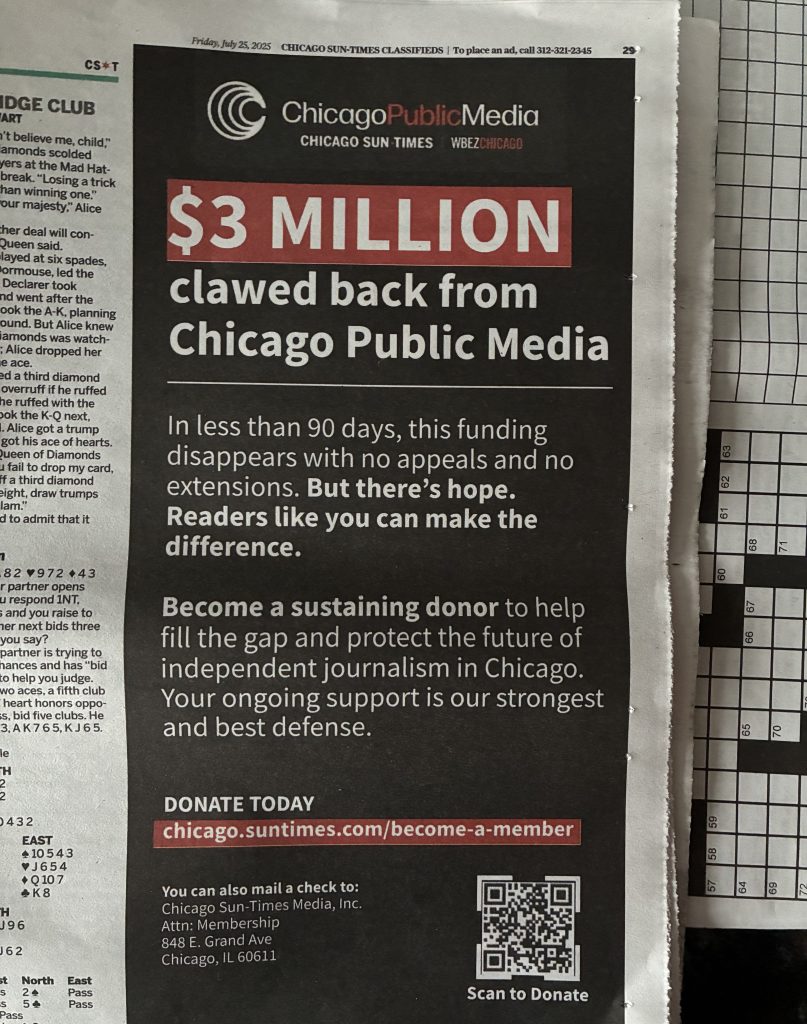
    Since then, I’ve been underwhelmed by this merger, which seems to have been more challenging than expected. I realize that the recently rescinded federal funding hasn’t helped, but I had assumed that Chicago Public Media would expect such an outcome, which has been a conservative goal for many years.

    I also had hoped that CPM would have resisted a reactionary response and instead would have offered a more brazen and bold reimagination of its contributions to metro Chicago and American democracy. Such a response would have reassured current supporters and inspired new ones.

    Perhaps CPM is starting to realize what it should do. Its CEO Melissa Bell, who described this rescinded funding as a “sudden loss,” nonetheless lauded the Chicago community for replacing 86 percent with “recurring community support” and to pledge a future of “true financial stability,” and twice the members, based upon a “100% community -funded model,” one that is “stable” and “independent” as if it couldn’t have had such plans in place even before that funding crisis.

    I also donate monthly to WBEZ in addition to my Sun-Times subscription, which given its free digital access seems like a second monthly donation. At the same time, I like many must carefully consider my expenses, especially as inflation increases, especially now that I’ve retired.

    Chicago is better with a second daily newspaper, and legitimate competitor. I hope that Bell and other CPM leaders know what they’re doing.

  • A Better Response?

    WBEZ as was predicted held a pop-up fundraiser this week.

    This station and National Public Radio have been citing the $1.1 billion loss to their member stations. This money had already been authorized for the Corporation for Public Broadcasting, and included in member station budgets, but Congress at Trump’s request eliminated this funding as a part of its recent recision.

    In response, too many public media representatives are talking about losses by focusing on the economic effects. Too few are offering inspiring, imaginative, and innovative visions of the way that public media will continue to exist.

    The problem isn’t acknowledging the economic effects, which is understandable. Rather, it’s that only doing so is failing the public at the time it most needs public media.

    These cuts have been threatened for years. This attempt increasingly seemed likely to be the one when conservatives withdrew public funding.

    Public media representatives in other words have had ample opportunity over many years to envision alternatives, and the worst has happened, which is actually an opportunity. Now is the time to offer an independent and bold vision for the future of public media not just to reassure existing donors but also to attract new supporters.

    I would actually welcome a forceful articulation for full public funding (e.g., McChesney 2008). At the very least, I encourage public media leaders to offer bold reimagings of public media today.

    Such an approach would transform what the current administration and congressional Republicans expect to be a devastating cost into a potential catalyst for greater independence. As such, it would announce that public media will no longer be dependent upon political whims.

    These observations come from a strong public media supporter. My biggest donations for example go to WBEZ, and I switched newspaper subscriptions after Chicago Public Media announced its new partnership with the Chicago Sun-Times newspaper.

    That explains my dismay over a recent Sun-Times subscriber survey. This request asked for feedback about which scenarios, such as fewer publication days or less opinion writing, would cause us to cancel our subscriptions.

    These seemingly fearful responses offer the wrong, and opposite, message. Public media are needed today perhaps more than ever.

    Facts are increasingly threatened. The information environment is increasingly polluted. Reason, deliberation, and other democratic, and American, values are endangered species.

    Leading in good times is easier. Leading in challenging times however offers good leaders chances at greatness.

    These public media leaders must speak to all of us, including existing donors and the general public. They must encourage us to imagine with them a better public media tomorrow.

    That is how I hope we endure the challenges confronting public media today.