Tag: Chicago Sun-Times

  • More From Moore

    More From Moore

    I can appreciate that Natalie Moore was able to watch both Prada movies with her mother but question the relevance of her most recent column.

    The sequel might have coincided as Moore suggests with a new Media Insight Project report, but it offers less about the future of media in the United States than she suggests. Rather, the movie relegates journalism, “Capital J” or not, to the setting for a continuing story that was started in the first movie.

    Corporate raiders might appear in the second to dismantle legacy publications, but the “page views” emphasis for example predates Andy’s return as the new features editor. Rather, the movie focuses primarily upon the relationship between Andy, who in her time away has become an award-winning journalist, and her former and future boss Miranda.

    This relationship, which occupies the center of this story, says more about time and aging, and the effects of these upon working relationships among women. Andy, who now trusts learned her instincts and advocates for herself, discovers that the world could be less vicious than she otherwise believed. Miranda in turn finds in Andy a former and perhaps future version of herself, someone who if they can collaborate will enhance both Miranda’s legacy and her life.

    This focus is not only established by the new working relationship between Andy and Miranda, but it is reinforced by the newfound friendship between Andy and her erstwhile rival Emily. Emily, who is working for Dior at the start of the movie, agrees to use her boyfriend Benji to buy the company and unbeknownst to Andy to install her in Miranda’s position, which Andy and Miranda subsequently prevent by finding yet another buyer, which nonetheless doesn’t prevent Andy and Emily from becoming friends.

    In this and other ways, this sequel is more about corporate relationships than the future of journalism, which makes this op-ed seem more like a vanity opportunity that allows Moore to reminisce about her mother and her career without offering much of substance to readers. This condition becomes even clearer in contrast with the only other op-ed in that Sunday newspaper.

    That reveals a larger concern, one that is actually about the future of journalism in Chicago. The Sun-Times seems to have generally reduced its op-eds, and some days offers none to its readers. Such circumstances can only increase the pressure for more from Moore, and from her editors and publisher.

  • Where Do You Go From Here?

    Where Do You Go From Here?

    I discovered this week that my seven-day Chicago Sun-Times delivery subscription rate had increased by more than thirty-three percent in one month.

    The Sun-Times rep couldn’t explain such a substantial increase, which she insisted had been shared in an email that I couldn’t locate even in my spam folder. She also couldn’t explain how this cost connected to the monthly WBEZ donations that I had been making for many more years than I had been a Sun-Times subscriber.

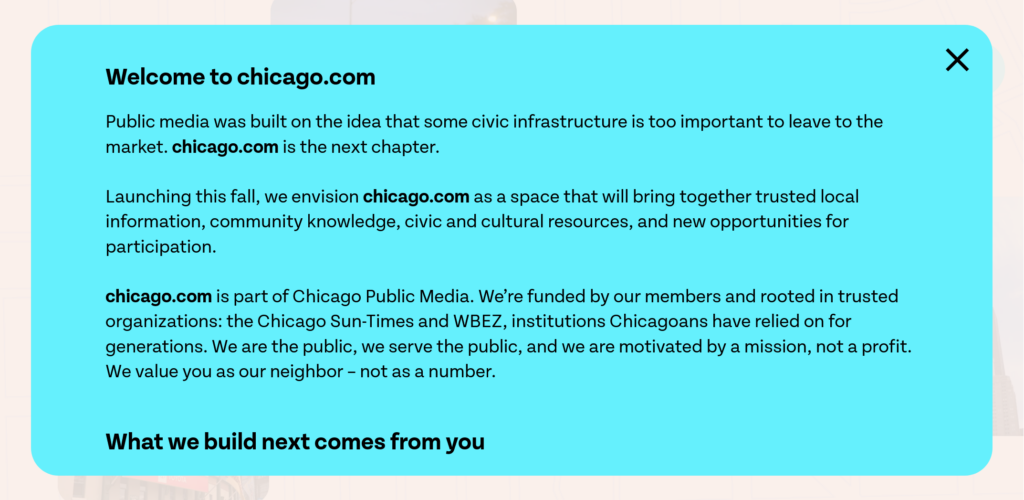
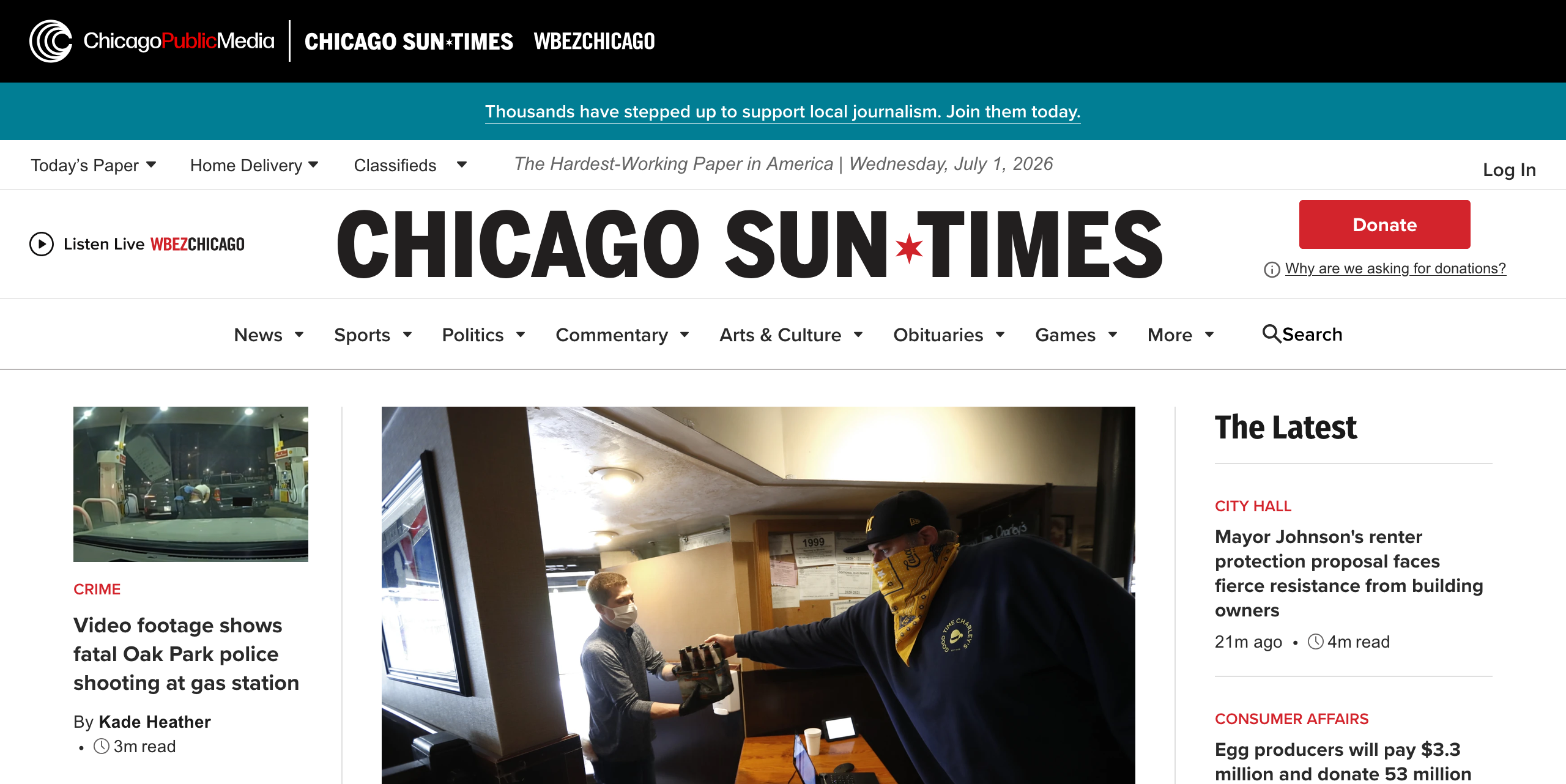
    Moreover, this increase was discovered in the same week that WBEZ announced its first on-air WBEZ fundraiser of the year, and the first without federal funding. Both are owned by Chicago Public Media, a nonprofit media company that acquired the newspaper in 2022, which made it “the largest nonprofit local news organization in the nation.”

    At that point, I had switched my newspaper subscription from the Chicago Tribune to the Sun-Times in support of public media. I’d generally prefer to have public media funded by the government as it is for example in Canada and elsewhere, which although problematic seems more reliable, but I recognize the political realities in the United States.

    One problem is that this new Sun-Times seven-day delivery rate is three times higher than the same Tribune rate at least for new subscribers. Another is that anyone can obtain the entire Sun-Times print version in electronic form through its website without spending any money.

    In other words, those of us who support Chicago Public Media, and prefer print newspapers, are spending a minimum of three times more than at least some Tribune subscribers. In exchange, we receive what everyone else can consume without any cost.

    A bigger problem is that the Sun-Times and WBEZ content seems to have decreased. Reports I initially hear on the radio for example or read in the newspaper will now reappear in the other form in what seems like a relatively recent overlap.

    Even worse is the way that new CPM leaders seemed unprepared for the present reality. They both seemed surprised by the federal funding loss, which is irresponsible given how often it had been threatened over the years, and have offered no coherent vision or detailed mission for its future, including one that explains the part that donors play.

    I don’t envy anyone in American public media whose existence depends upon the largesse of public. At the same time, I believe that the present state of public media in the United States could offer an opportunity to reimagine a more independent model, one that is both visionary and inspiring.

    If Chicago Public Media did that, they would also suggest that they will be good stewards of our support, which could reassure current donors and motivate new ones.

  • Texts Today

    Texts Today

    I’ve had my issues with the Chicago Sun-Times, but I’m objecting this time to recent comments from one of its writers.

    Sun-Times columnist Neil Steinberg wrote one that was ostensibly about why Chicago Children’s Museum had missing lights on a recent national broadcast. He elsewhere described it as “a columny sort of column” from “a columnist for column readers,” and admitted his uncertainty whether the newspaper would even publish it.

    The reason he suggests is that its features — “something chatty, a little funny, with a voice” — represents a kind of article that is disappearing over time. He offers no evidence but should know, and probably isn’t wrong.

    Such a claim could however have made the same claim about all newspaper articles generally. Newspapers as has been reported are disappearing across the United States, in which case readers would have fewer opportunities to encounter all newspaper articles, and not just “chatty” and “funny” ones that have “a voice.”

    Steinberg is suggesting I realize that forms, or genres, of newspaper articles seem to be changing, but that again isn’t particularly insightful. The medium as media critic Marshall McLuhan explained in 1964 is its message — content and “character” — and perhaps even more so after the appearance of the internet, social media, or AI today.

    The more interesting issue I believe can be found not in Steinberg’s comment but its connotations, particularly the suggestion of nostalgia and loss. Are “columny columns” better than the versions that are placing these?

    Should we lament the loss in other words of the “something chatty, a little funny, with a voice” columns? Are columns or while we’re at it other traditional journalistic genres inherently better than other kinds, including blog posts and social media to which he also turns?

    Steinberg’s opinion I believe cannot be separated from his ideas about his reputation for example or his need for continued employment. The rest of us might have different answers, but these must be considered contexts in which genres emerge, evolve, and are sometimes even eliminated.

    Discursive changes, like those in life, are unavoidable, and conclusions about whether such changes are unproductive or undesirable are debates worth having before offering opinions even throwaway ones.