Tag: social justice

  • The First Thing We Do

    The First Thing We Do

    I admire Zindy Marquez’s courage in confronting those of us who are retreating from “sustained advocacy, policy reform, civic engagement[,] and long-term commitments” to “racial justice” as these have become “politically and culturally unpopular,” and think she is right.

    I agree that those who believe that the United States isn’t still shaped by institutionalized inequality are ignoring “the very systems that continue to produce inequitable outcomes today,” and that such “coordinated” efforts misrepresent the past and distort the present to dictate an unequal future. And I accept her claims about the Chicago Lawyers’ Committee for Civil Rights and the communities with which it collaborates.

    I just think she has offered an incomplete account of the problem.

    Marquez to her credit mentions those who found the pursuit of social justice “easier in theory than in sustained practice,” but she ignores both the history of this inconsistency and the conditions of its continuation. In contrast, I would include the hypocrisy among activists, lawyers, teachers, and others

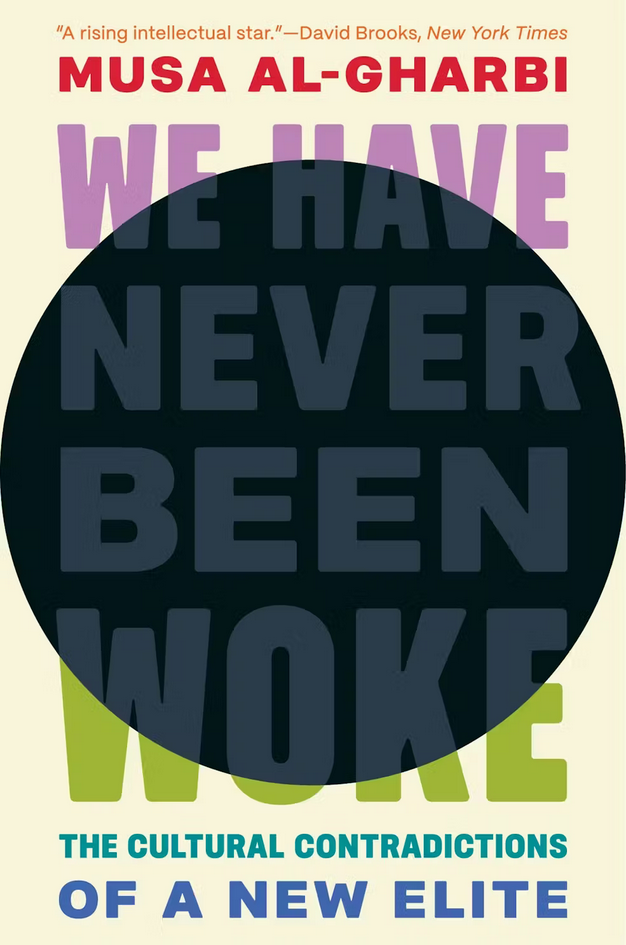
    Such conditions have been convincingly documented by Musa al-Gharbi (2024) in WE HAVE NEVER BEEN WOKE. He offers in this book a compelling account of the way that symbolic capitalists, or those whose status or prestige comes from the knowledge economy, have used social justice discourse, and especially cultural identity discussions, to increase their own influence while ignoring the underlying economic conditions, including their own position within such a hierarchy.

    Anyone who hasn’t read this book and cares about social justice should do so to discover the ways that we maintain existing inequalities while espousing the opposite. Such insights might make us more likely to make more productive changes, or at least more aware of the efforts we need to make if we’re to do so.

    These efforts could also challenge the persistent impression among some that progressives cannot be trusted to work and live with professional and personal integrity, which might mean more allies. If nothing else, these reduce the source of examples used by these “coordinated” critics.

    This fuller account might mean we avoid replacing one social hierarchy with another, which merely reverses this discrimination without moving the United States forward. At least it offers a more appealing account of institutionalized inequality and more convincing arguments about alternative, including shared sacrifices for a greater good.

    Those who pursue greater social justice do much harm by promoting our intellectual and moral superiority. Instead, we should demonstrate the existence of this discrimination, including the part we play in perpetuating it, and the greater benefits of more equitable options, and must do so in good faith over and over, and not just in our political ideas but also our personal choices with an obvious respect for everyone, including those with whom we disagree.

    That is a better, and potentially more productive, way to care for our entire community as we pursue a more perfect union, one in which everyone is more equal than we all are now.
  • The Rest of Us

    The Rest of Us

    I wonder what Stacy Davis Gates thinks of us.

    Gates, who is president of both the Chicago Teachers Union and the Illinois Federation of Teachers, recently argued that CPS is transforming into a “sustainable community school district” of community “anchors” as a result of the recent Chicago Board of Education approved five-year equity plan and four-year union contract. These will produce “the schools our students deserve” and “true community hubs” that reflect local neighborhoods and are “responsible to students and families” within these.

    The CTU and the Board in rejecting previous privatization of education posit schools as spaces of “stability, access and care” that also address larger social problems, such as food deserts and health care gaps. Such schools both “educate young people” and “reflect and uplift entire communities” by extending support beyond classrooms and integrating local needs with learning.

    This Sustainable Community Schools approach, which according to Gates originated in Chicago, has been embraced by other cities. At its center is a concern for students and their families that supports both “personal agency” and community development.

    I’m not surprised that a teachers union president would advocate for schools as central to society. I sometimes wondered as a professor and a parent why what happened in universities where I worked and schools where my kids learned often seemed separate from what happened beyond these institutions.

    I just never assumed that public schools were the only, or even best, ways to care for Chicago students and their families. I knew that private schools do so too as do other initiatives and institutions, such as After School Matters and the Chicago Park District.

    I realized in other words that schools exist within a larger social context. In other words, education while important isn’t everything, and certainly cannot matter more than reliable roads for example or public safety, which also matter, and must be supported, by those of us who call Chicago home.

    Gates in her defense recognized this economic element in acknowledging the need for additional revenue. At the same time, she misrepresents this situation, and denies its difficulty, by describing it as a need for “a fairer tax system” as if such a perception is a citywide consensus even though it clearly is not.

    In fact, the Chicago City Council members (and Illinois legislators) seem unconvinced of the need for a corporate head tax, a property tax increase, and other self-styled “progressive” taxes proposed by the Chicago mayor, a former CPS teacher and CTU-organizer whose election was the result of the CTU support. Moreover, this failure and other challenges to this mayor’s fiscal policies, governing approach, ethical standards, and even political competence could demonstrate the danger of putting educators in charge.

    I would suggest that this this risk can also be seen in Gates herself, and the way she models a progressive hypocrisy that has been convincingly documented by Musa al-Gharbi (2024) among educators and other social elites. For example, Gates has defended her decision to send her son to a private school in what seems like a classic case of public-schools-for-thee-but-not-for-me.

    I’m perhaps as concerned in the end about the effects upon public perceptions of the CTU and unions generally. Gates might be an effective at obtaining results for union members but by overreaching in both this equity plan and union contract risks alienating those who might otherwise be sympathetic to unions.

    The only thing worse than a union, I’ve said, is no union. The better ones I believe recognize their purview and purpose, collaborate with comparable communities, and create coalitions with other constituencies to support shared goals and similar ends, which require a humility that seems scarce in the CTU and its president.

    Reasonable people can disagree on the distribution of funding across public and social services for example or the proper role of schools and education. As a result, these debates need to be ongoing, and relitigated each time budgets are prepared.

    Budgets obviously reflect values, and Chicago, and Illinois, might need to value education more. Neither however can afford to prioritize education over everything else, especially without a citywide consensus, and not just one within CTU.

    These discussions and decisions are difficult, and must be made by those whom all of us have elected, and not educators who have been elected (or bankrolled) by CTU members.

  • Theater Today

    Theater Today

    I attended the final production of Manual Cinema’s The 4th Witch this past weekend, and was elated at the outset.

    I had forgotten how thrilling live performance can be. I unfortunately had sufficient time throughout the rest of the performance to contemplate the relative absence of theater in my life.

    Its presence dramatically diminished once I left a theater awards organization. For eight years, I had been a theater judge, and was seeing more than one hundred, and sometimes more than two hundred, different productions each year.

    I left the organization as a result of its lack of professionalism, and its resistance to professional development, and its leaders’ lack of integrity and ethics. I was also was concerned about the amount of time that I was spending at less than noteworthy productions, which were hours of our lives another judge reminded me that we’d never get back.

    For the first year or two, I resumed my theater subscriptions, which meant that I was attending fifteen to twenty performances a year. That effectively reduced my attendance rate, which allowed more space and time for other activities, but inadvertently increased the costs, which now included money. A single theater subscription, which could include four, five, or six performances, could cost several hundred dollars a season even for preview performances or midday matinees.

    These increased costs I admit could have highlighted the diminished quality, or could have made it more salient. Such a trend had been evident when I was still a theater judge, especially after the pandemic when theaters rushed to respond to the loudest calls for a more woke world.

    Such calls could have been coming from those who were first to return to theaters, or the ones who most often attended shows. Regardless, these calls seemed to pressure theaters into featuring the same systemic racism themes that had a long presence even before the 2020 “We See You, White American Theater” missive.

    Theater as the most synthetic of art forms has a tradition of featuring such themes, and pushing social and artistic boundaries. Such a tradition is evident in the United States, as illustrated for example in August Wilson’s call for tradition and change, and even here in Chicago, which has made numerous contributions to theater both across the United States and around the world.

    Post-pandemic American theater however seemed more concerned about placating patrons, and in so doing became too timid. Too often, snapping, and easy laughs, rippled across too many darkened theaters in response to one intellectually and emotionally insulting scene after another.

    Most theaters, or at least the ones I had long been attending, seemed to reinforce mainstream liberal mentalities, and to refuse to reckon with the never-been-woke realities of too many social justice initiatives. So I stopped subscribing.

    I still cannot rationalize these costs, especially now that I’m retired. Maybe I wondered this weekend I never will.

    The challenge confronting theaters is to some extent understandable, and a perpetual question in debates about the economics of art. Realistic answers require a careful balance of finances and function.

    Regardless, American theater could confront the political economies of theater today, and rebalance its approach in ways that don’t compromise accessibility and affordability and challenge and change. To this end, Chicago again offers ideas, such as the Hull House approach or the little theater movement in the early twentieth century or the little theater movement soon thereafter to the storefront tradition in the late twentieth- and early twenty-first centuries.

    These and other approaches offer accessible and accountable art, ones that theaters here in Chicago and elsewhere would be wise to consider. And these could mean more thrilling theater for me too.