Tag: WBEZ

  • Where Do You Go From Here?

    Where Do You Go From Here?

    I discovered this week that my seven-day Chicago Sun-Times delivery subscription rate had increased by more than thirty-three percent in one month.

    The Sun-Times rep couldn’t explain such a substantial increase, which she insisted had been shared in an email that I couldn’t locate even in my spam folder. She also couldn’t explain how this cost connected to the monthly WBEZ donations that I had been making for many more years than I had been a Sun-Times subscriber.

    Moreover, this increase was discovered in the same week that WBEZ announced its first on-air WBEZ fundraiser of the year, and the first without federal funding. Both are owned by Chicago Public Media, a nonprofit media company that acquired the newspaper in 2022, which made it “the largest nonprofit local news organization in the nation.”

    At that point, I had switched my newspaper subscription from the Chicago Tribune to the Sun-Times in support of public media. I’d generally prefer to have public media funded by the government as it is for example in Canada and elsewhere, which although problematic seems more reliable, but I recognize the political realities in the United States.

    One problem is that this new Sun-Times seven-day delivery rate is three times higher than the same Tribune rate at least for new subscribers. Another is that anyone can obtain the entire Sun-Times print version in electronic form through its website without spending any money.

    In other words, those of us who support Chicago Public Media, and prefer print newspapers, are spending a minimum of three times more than at least some Tribune subscribers. In exchange, we receive what everyone else can consume without any cost.

    A bigger problem is that the Sun-Times and WBEZ content seems to have decreased. Reports I initially hear on the radio for example or read in the newspaper will now reappear in the other form in what seems like a relatively recent overlap.

    Even worse is the way that new CPM leaders seemed unprepared for the present reality. They both seemed surprised by the federal funding loss, which is irresponsible given how often it had been threatened over the years, and have offered no coherent vision or detailed mission for its future, including one that explains the part that donors play.

    I don’t envy anyone in American public media whose existence depends upon the largesse of public. At the same time, I believe that the present state of public media in the United States could offer an opportunity to reimagine a more independent model, one that is both visionary and inspiring.

    If Chicago Public Media did that, they would also suggest that they will be good stewards of our support, which could reassure current donors and motivate new ones.

  • Sunnier Days Ahead?

    Sunnier Days Ahead?

    I’ve known for weeks that I need to make some difficult decisions about newspaper subscriptions.

    I currently have daily Chicago Sun-Times delivery, and also receive the Chicago Tribune on Sundays. I also prefer print versions although I’ll read the Tribune opinion articles on a tablet throughout the week.

    I had traded the New York Times for the Tribune soon after moving to Chicago more than twenty years ago. I switched to the Sun-Times in 2022 after it became a part of the Chicago Public Media.

    Since then, the Sun-Times has lost much of its allure. More journalists for example seem to be doing cross-over work for the CPM radio station. Also, it recently dissolved its editorial board, and stopped producing editorials, and has fewer op-eds, and some days none at all.

    At the same time, the Sun-Times informed me that it was increasing its cost. After that, I was spending more — $9.50 for the daily Sun-Times each week in contrast to $7 for daily Tribune delivery — although I was assured that it would reduce my rate to $7.70 / week, which only raises more questions about the ways the Sun-Times treats its subscribers.

    Both newspapers seem to be nudging readers to go digital. Those who wish to pay for their journalism for whatever reason will spend $7-$15 / month to support the Sun-Times or $5-$7 for the Tribune. (The difference is access to local coupons or events.) Both newspapers at the moment also seem to offer electronic versions of its print papers for free, which raises a different set of questions about the future of journalism more generally.

    Daily Sun-Times subscription in other words costs more for less, and both newspapers are available, and more affordable, online if subscribers read these in electronic format.

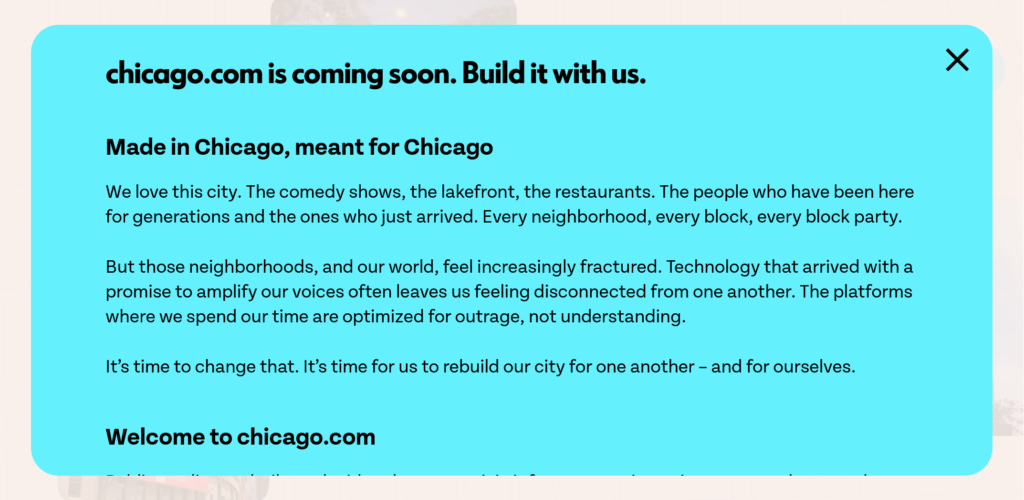
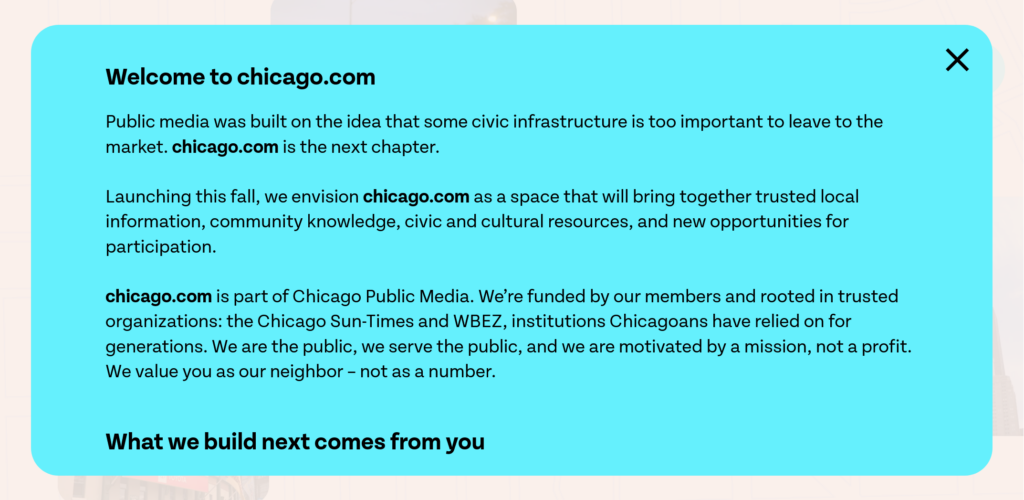
    The bigger problem for me is the future of journalism. The reason I switched several years ago to the Sun-Times was to support a public media approach. I had long been impressed by the work WBEZ does, and I hoped that would stabilize and even develop the Sun-Times, which could only be good for Chicago.

    Such an outcome would strengthen the future of two competitive newspapers, which could challenge each other for their coverage. Moreover, it could expand audiences, and even offer a counterbalance to the hedge fund that had purchased the Tribune in 2021.

    Since then, I’ve been underwhelmed by this merger, which seems to have been more challenging than expected. I realize that the recently rescinded federal funding hasn’t helped, but I had assumed that Chicago Public Media would expect such an outcome, which has been a conservative goal for many years.

    I also had hoped that CPM would have resisted a reactionary response and instead would have offered a more brazen and bold reimagination of its contributions to metro Chicago and American democracy. Such a response would have reassured current supporters and inspired new ones.

    Perhaps CPM is starting to realize what it should do. Its CEO Melissa Bell, who described this rescinded funding as a “sudden loss,” nonetheless lauded the Chicago community for replacing 86 percent with “recurring community support” and to pledge a future of “true financial stability,” and twice the members, based upon a “100% community -funded model,” one that is “stable” and “independent” as if it couldn’t have had such plans in place even before that funding crisis.

    I also donate monthly to WBEZ in addition to my Sun-Times subscription, which given its free digital access seems like a second monthly donation. At the same time, I like many must carefully consider my expenses, especially as inflation increases, especially now that I’ve retired.

    Chicago is better with a second daily newspaper, and legitimate competitor. I hope that Bell and other CPM leaders know what they’re doing.

  • Not Again WBEZ

    Not Again WBEZ

    WBEZ is fund-raising again this week.

    The ostensible goal is replacing the remaining rescinded federal funds — around $150,000 of about $3 million as of yesterday morning — by the end of this week. The station in other words has reportedly replaced about $2.85 million, or ninety-five percent, as of this week and had about five percent more to go at the start of this “pop-up” fund-raiser.

    I still believe in public media, and wish these were fully funded with our tax dollars although I’m less sanguine about such a model than ever. I just think WBEZ is still operating on a flawed assumption, and in so doing insulting its listeners’ intelligence.

    One on-air person for example suggested yesterday that this loss was the equivalent of a month of broadcasting. She asked listeners to imagine eleven months of news and then one month of nothing.

    Such a scenario not only is unrealistic and unnecessary but also would be irresponsible. Moreover, this funding loss shouldn’t have surprised any perceptive person who knows that federal funding threats appeared long before the second Trump administration, which only increased their likelihood.

    Budgets are obviously choices. As a result, WBEZ could, and perhaps should, reconfigure its budget without this federal funding, and only expand it based on additional reliable funding.

    The station obviously should pursue additional reliable funding now perhaps more than ever. It could also reimagine its contributions and function, especially now that it needn’t worry about placating politicians anymore.

    WBEZ at least is no longer beholden to the federal government for the equivalent of one month of funding. Now it can boldly, and even brazenly, reimagine its role in metro Chicago and American democracy.

    Such a response would reassure existing donors that the station has been a good steward of our contributions. It also could inspire individuals, both new donors and existing ones, to contribute to this bold and brazen alternative, one that gives hope to the future of public media and our country.

    That beats begging for bucks to replace what this bully has taken.