Tim Berners-Lee’s (2025) recent memoir, which he co-wrote with Stephen Witt, is an invaluable account of the invention of the internet and useful counterbalance to mainstream accounts of it.
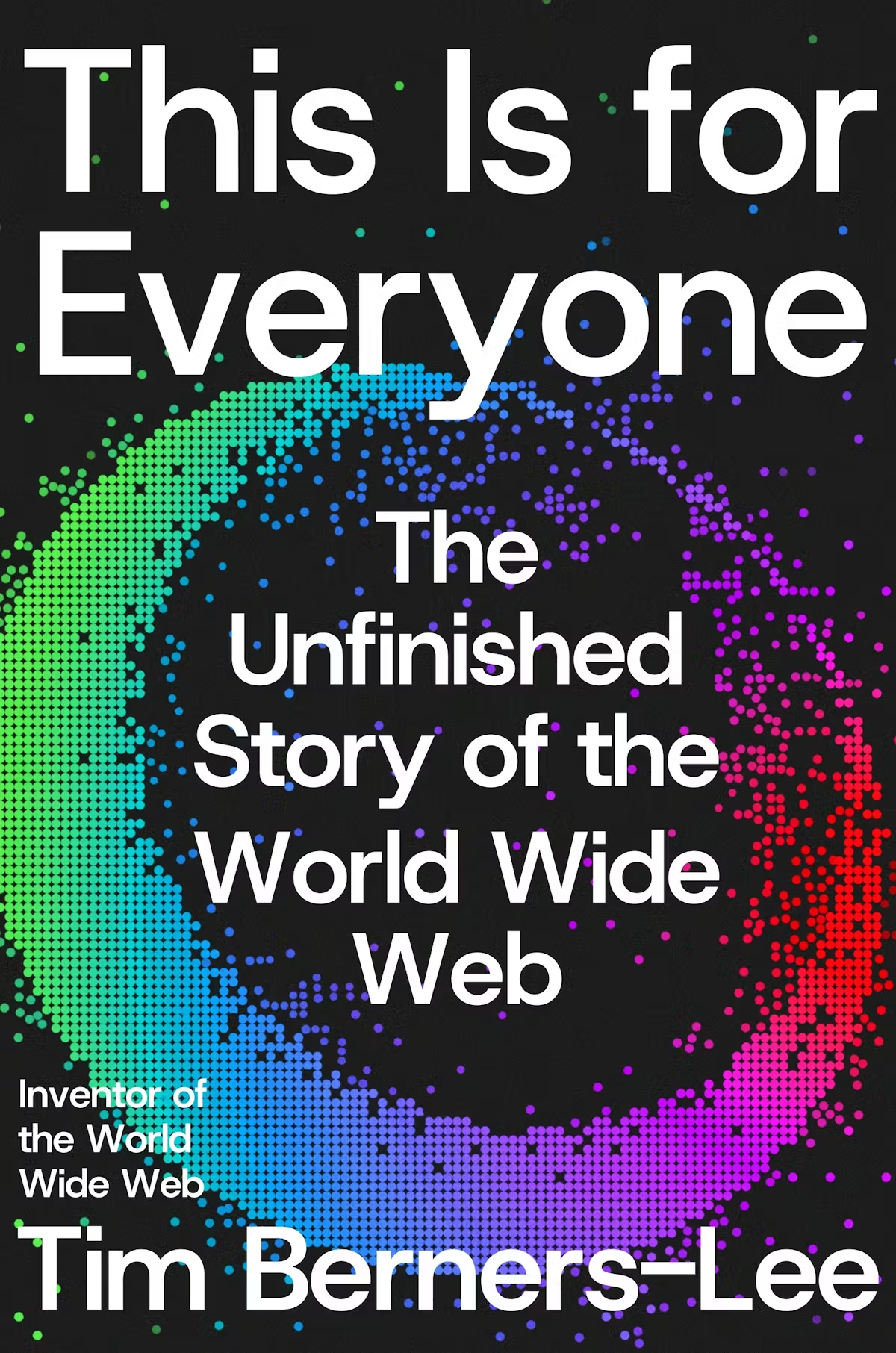
Berners-Lee recounts his experiences from imagining a world-wide web, convincing CERN administrators in 1989 to support his proposal, and its stunning evolution since then into the backbone for contemporary digital life. He also considers other central concerns, such as content moderation, platform monopolies, and artificial intelligence, along the way.
Central to this account are the central principles in Berners-Lee’s original vision. This vision was, and still is, an open network as a positive tool for human connections that is available to everyone, and not controlled by any single institution or individual.
I was elated to learn that the internet inventor is still promoting an open and accessible space. He touts for example open-source software and federated platforms, such as LibreOffice and Mastodon, and he is developing personal data pods or wallets, and in so doing promoting data sovereignty.
I was particularly interested near its end by his distinction between attention and intention economies, or what we’re currently experience and what he envisions for us. In doing so, Berners-Lee rejects both AI-doomers and AI-boomers — he acknowledge challenges and dangers, and criticizes the profit-driven approaches, but embraces the relative advantages — and advocates for in an AI-era reset.
I found the rhetorical approach to be too episodic at times. One moment is followed by another and then another, and these are compiled and then offered as significant, and too infrequently connected to larger themes.
I wanted more interpretation, synthesis, and conclusion from such a visionary and hopeful thinker. That though doesn’t mean he isn’t offering a vision of a different digital world, one that is also evoked by recent antitrust lawsuits against Google for example and Apple and successful verdicts against social media companies.
Surely the one who imagined a networked world must be proud of his creation, and those who continue to develop it.
Leave a Reply