Category: national

  • A Better Response?

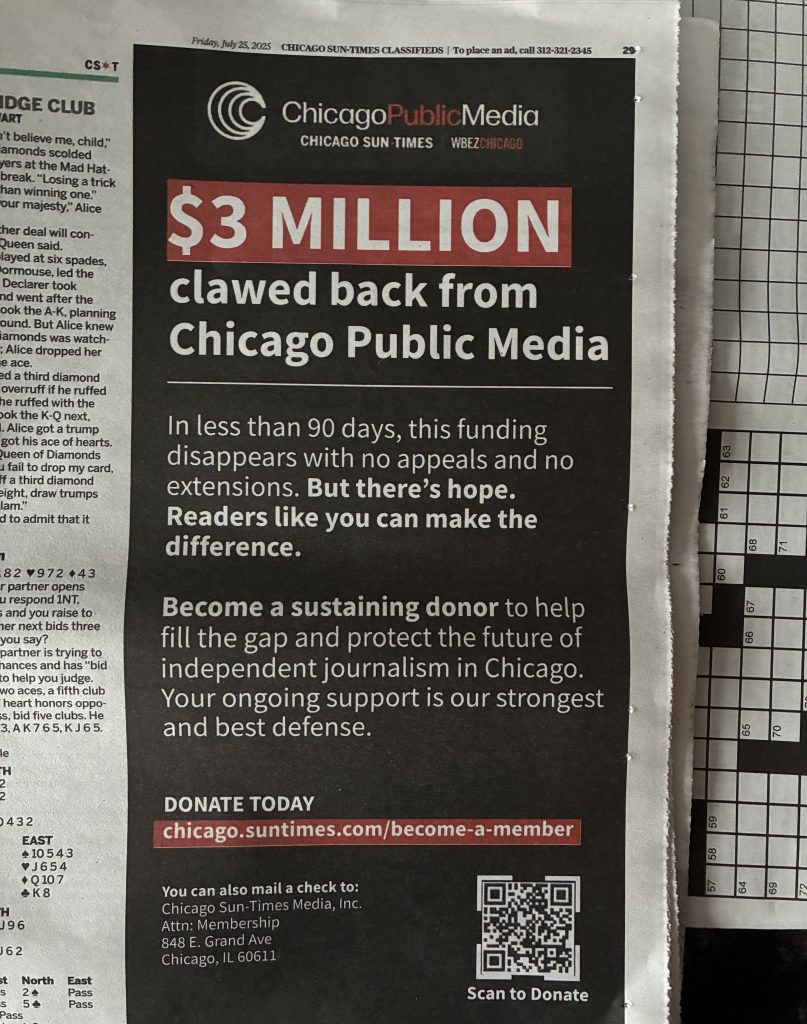
    WBEZ as was predicted held a pop-up fundraiser this week.

    This station and National Public Radio have been citing the $1.1 billion loss to their member stations. This money had already been authorized for the Corporation for Public Broadcasting, and included in member station budgets, but Congress at Trump’s request eliminated this funding as a part of its recent recision.

    In response, too many public media representatives are talking about losses by focusing on the economic effects. Too few are offering inspiring, imaginative, and innovative visions of the way that public media will continue to exist.

    The problem isn’t acknowledging the economic effects, which is understandable. Rather, it’s that only doing so is failing the public at the time it most needs public media.

    These cuts have been threatened for years. This attempt increasingly seemed likely to be the one when conservatives withdrew public funding.

    Public media representatives in other words have had ample opportunity over many years to envision alternatives, and the worst has happened, which is actually an opportunity. Now is the time to offer an independent and bold vision for the future of public media not just to reassure existing donors but also to attract new supporters.

    I would actually welcome a forceful articulation for full public funding (e.g., McChesney 2008). At the very least, I encourage public media leaders to offer bold reimagings of public media today.

    Such an approach would transform what the current administration and congressional Republicans expect to be a devastating cost into a potential catalyst for greater independence. As such, it would announce that public media will no longer be dependent upon political whims.

    These observations come from a strong public media supporter. My biggest donations for example go to WBEZ, and I switched newspaper subscriptions after Chicago Public Media announced its new partnership with the Chicago Sun-Times newspaper.

    That explains my dismay over a recent Sun-Times subscriber survey. This request asked for feedback about which scenarios, such as fewer publication days or less opinion writing, would cause us to cancel our subscriptions.

    These seemingly fearful responses offer the wrong, and opposite, message. Public media are needed today perhaps more than ever.

    Facts are increasingly threatened. The information environment is increasingly polluted. Reason, deliberation, and other democratic, and American, values are endangered species.

    Leading in good times is easier. Leading in challenging times however offers good leaders chances at greatness.

    These public media leaders must speak to all of us, including existing donors and the general public. They must encourage us to imagine with them a better public media tomorrow.

    That is how I hope we endure the challenges confronting public media today.

  • Play Ball

    Baseball begins again today.

    The All-Star break for many fans is the unofficial halfway point in the season. The actual midway point at least for the Chicago Cubs came fifteen games earlier.

    The Cubs entered the break in the NL Central first place. This team also has the second-best NL record, and the third-best of all MLB teams, and three Cubs players were chosen for the all-star team.

    Most teams know by this point whether they’re sellers or buyers before the trade deadline later this month although the current wild card format can complicate such conclusions. Regardless, all teams have a few more days to lock their rosters for the remainder of this season.

    These all-star breaks always surprise me. Teams have had occasional off-days, so that isn’t the issue. Rather, it’s the accumulative five days total that seems so significant.

    Days one and two require me to find something else to structure my days. Day three or four usually finds me thinking beyond baseball, and the days after the season ends.

    That for most teams usually comes in September, which always feels too soon. Some teams will play into October, but the rest are storing equipment, washing uniforms, and doing whatever else must be done, including spending their days somewhere besides baseball stadiums.

    All teams will be done, and dormant, by the middle of November as the Midwestern air carries a consistent chill, the mornings bite a bit, and summer shorts are also washed, folded, and shelved. Halloween will have given way to Thanksgiving, which is followed by the Christmas and New Year’s holidays.

    The next two months are usually barren, fallow times. Little pulls my attention beyond the walls of warm buildings, where I spend most of my time.

    My mind will eventually return to baseball. At some point, I’ll count the weeks until pitchers and catchers report, which I will dutifully report.

    That and more I know is soon to come. For now, the season resumes, which will be enough.

    Players return to diamonds and roadtrips. Some, like the Cubs, will count every win and loss, which will be compared other teams’. Others, such as the Chicago White Sox, will count the number of games until the 162 merciful conclusion.

    Only a few teams will amass enough wins — that once was 100 but often fewer will do — to get into the playoffs. At that point, most bets are off, or at least must be reconsidered.

    And once again I’ve been reminded that all this ends, that this too shall pass, and that baseball season one day at least for me will never begin again. I might not know when that will be but can be confident that it will occur, which is a useful reminder, especially this year as I consider an encore career or complete retirement.

    This break reminds me that none of this lasts forever, and that today is all that matters. That is terrifying yet invigorating, somehow melancholic and beautiful at the same time.

    And I can root for the Cubs again today, return to Wrigley once the days cool, and this year reclaim my hope for October baseball once more.